

Yes, you can buy just lobster meat without the shell, sold as picked or shucked lobster meat in cooked and raw forms. Shell-free does not mean ready to eat: check the cooking status, which parts of the lobster are included, and whether the package is refrigerated or frozen before choosing it for your recipe.
- Can you buy just lobster meat without the shell? Yes—look for picked or shucked lobster meat.
- Choose cooked lobster meat for rolls and salads; raw lobster meat requires cooking.
- A lobster tail listing does not establish that the shell has been removed.
- Onatru ships restaurant-quality seafood nationwide; confirm shell-free preparation before ordering a specific item.
Can you buy just lobster meat without the shell?
Yes. Seafood sellers offer lobster meat removed from the shell, but you need to read beyond the product name to know what preparation remains. Shell status, cooking status, and storage condition are separate details. A frozen package can contain either raw or cooked meat.
Use this comparison when shopping in 2026. These are product categories, not a statement that every seller carries every option.
| Lobster format | Best for | Main advantage | What to check or accept |
|---|---|---|---|
| Cooked, picked meat | Lobster rolls and chilled salads | No shell removal or raw cooking step | Requires safe refrigeration and gentle handling |
| Raw, shell-free meat | Recipes that cook the lobster directly | Lets you control the cooking | Must be cooked before eating |
| Shell-on tails | A plated lobster dinner | Keeps the tail intact for presentation | Still requires shell handling |
| Whole lobster | A traditional lobster meal | Includes meat from several parts | Requires cooking and picking unless explicitly prepared otherwise |
Onatru sells restaurant-quality seafood and ships nationwide to home cooks. Confirm the exact preparation on the item you intend to order; the words lobster or lobster tail alone do not answer whether it is shell-free.
Why this matters
Buying the right format removes work from dinner rather than shifting it to an unexpected moment. If you want to fill toasted rolls, cooked picked meat fits that task more directly than a raw tail that still needs cooking and shell removal.
The distinction also affects portions. A shell-on package weight includes material you will not serve, so it is not interchangeable with the same weight of picked meat. Build your shopping list around edible meat, not the apparent size of the package.
Cooked, picked lobster meat: best for rolls and salads
Choose cooked, picked lobster meat when you want to skip both shell removal and cooking raw lobster. It suits lobster rolls, chilled salads, and other dishes where you fold the meat into a finished preparation.
Look for an explicit statement that the meat is fully cooked. Neither a pinkish appearance in a photograph nor the word picked establishes cooking status; picking describes shell removal.
The benefit is straightforward preparation. The trade-off is less room for additional cooking: prolonged heat can toughen lobster that has already been cooked. For a warm dish, prepare the surrounding ingredients first and follow a recipe written for cooked lobster.
Cooked lobster still needs safe handling. Use clean utensils, keep it refrigerated while preparing other ingredients, and follow the package's storage and use instructions. Ready to eat does not mean safe to leave on the counter.
Raw, shell-free lobster meat: best for cooking into a dish
Choose raw, shell-free lobster meat when your recipe cooks the lobster itself. Removing the shell does not remove the need for a cooking step, and a recipe written for cooked meat is not automatically suitable.
The advantage is control over doneness without picking meat from a shell afterward. The drawback is that you must handle it as raw seafood, keeping it separate from bread, salad greens, and other ready-to-eat ingredients.
For home cooking in 2026, FDA seafood guidance gives 145°F as the internal cooking temperature for most seafood. Check the thickest part with a food thermometer, and follow any specific product preparation instructions.
Do not substitute a brief warming step for cooking raw lobster. If your recipe says to fold cooked lobster into a finished sauce, cook raw meat separately before making that substitution.
Claw, knuckle, or tail meat: which should you choose?
Match the pieces to the dish, rather than treating one cut as the right answer for every meal. The package description should identify the parts included; an attractive serving photograph is not a substitute for that information.
| Meat selection | Best for | Practical benefit | Trade-off |
|---|---|---|---|
| Claw and knuckle meat | Rolls, salads, and mixed fillings | Pieces work well in a folded mixture | Less suited to a uniform tail-style presentation |
| Tail meat | Dishes featuring intact or sliced tail meat | Supports a more structured presentation | Large pieces need attention to even cooking or warming |
| Mixed lobster meat | Pasta, chowder, and combined dishes | Different pieces can work together in one recipe | The mix and piece size require checking |
Claw and knuckle meat works naturally in a lobster roll because you are making a filling, not presenting an intact tail. Tail meat makes sense when the shape matters on the plate. Mixed meat is useful when the recipe combines lobster with other ingredients.
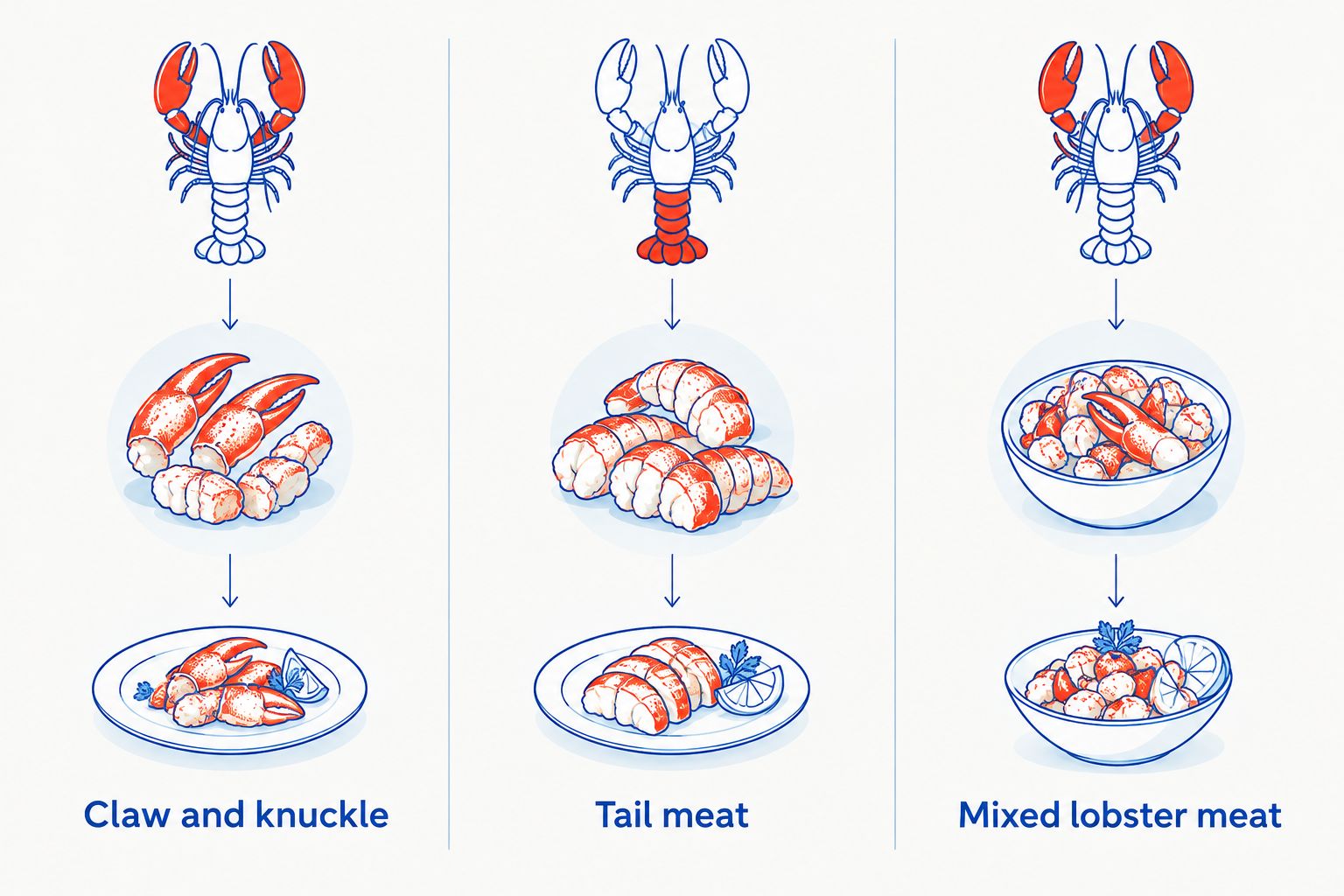
Whatever cut you choose, inspect picked meat for stray shell fragments before serving. That quick check is especially useful before folding lobster into a filling where small fragments become harder to spot.
How to check a shell-free lobster listing in 2026
Read the description as a preparation checklist. You want a clear answer to each question before ordering, especially when the product title uses abbreviations or an unfamiliar pack format.
- Confirm shell removal. Look for wording such as picked, shucked, shell-free, or meat only. If the wording is unclear, ask rather than interpreting the photograph.
- Confirm cooking status. Find an explicit raw or fully cooked designation. This determines your food-safety handling and the recipe you can use.
- Identify the cut. Check whether the package contains claw, knuckle, tail, or a stated mixture. Choose pieces that suit your intended dish.
- Read the quantity. Distinguish the weight of an individual package from a case total. Check whether the weight describes edible meat or a shell-on product.
- Check ingredients and handling instructions. Read any added ingredients, thawing directions, refrigeration requirements, and instructions for use after opening.
- Confirm delivery details. Check the delivery coverage, packing information, and receiving arrangements for your address. Do not infer a delivery date from a general nationwide-shipping statement.
For Onatru seafood orders, use the contact page to clarify shell removal, cooking status, or pack quantity when a listing does not answer your question. Ask about cold-packed handling for the exact item rather than assuming every seafood format travels under identical conditions.
A useful question is simple: does this package contain only lobster meat, is it raw or fully cooked, and how much edible meat does it contain? Those answers tell you more about dinner preparation than a broad quality description.
Why shell-free lobster preparation varies
The work left in your kitchen depends on more than whether the shell is gone. Use these factors to compare products without assuming that every package marked lobster meat behaves the same way.
- Cooking status: Fully cooked meat needs a different recipe approach from raw meat. Establish this before planning your method.
- Cut selection: Claw, knuckle, and tail pieces have different shapes. Match them to a filling, mixed dish, or plated presentation.
- Storage condition: Frozen meat needs a thawing plan; refrigerated meat needs a receiving and storage plan.
- Piece size: Intact pieces and smaller pieces do not need identical handling. Avoid breaking up meat unnecessarily when presentation matters.
- Pack format: A large frozen block is less convenient for a small meal than separately packed portions. Check how the meat is packed before ordering.
- Recipe sequence: A cold roll filling, warm pasta, and baked casserole expose lobster to different amounts of heat. Use instructions suited to the meat's cooking status.
Choose the recipe first, then choose the lobster format. This keeps convenience tied to the meal you actually want to make.
How should you receive and store lobster meat?
For a 2026 delivery, make room in the refrigerator or freezer before the package arrives. Open the delivery promptly, inspect the food and packaging, and follow the seller's receiving instructions.
FDA guidance for delivered perishable food calls for food to arrive frozen, partially frozen with ice crystals, or refrigerator-cold at 40°F or below. Check the food's condition rather than judging safety by the outer box or the presence of packing material alone.
If the seafood arrives warm or you cannot establish safe handling, do not taste it to investigate. Contact the seller and do not serve it while the concern remains unresolved.
For thawing, follow the package directions and use the refrigerator rather than the countertop. Keep raw seafood contained so drips cannot reach ready-to-eat food. If vacuum packaging carries instructions to remove or open the packaging before thawing, follow them.
FDA consumer food-safety guidance also limits perishable food at room temperature to 2 hours, or 1 hour when the temperature is above 90°F. These limits apply to preparation and serving as well as time spent unpacking.
How do you plan portions without buying shell weight?
Start with the recipe's required weight of edible lobster meat. If the recipe calls for picked meat, compare it with a package explicitly described as meat only—not a whole lobster or shell-on tail of the same weight.
Decide whether lobster is the main feature or part of a larger dish. A lobster roll, a pasta with several ingredients, and a small appetizer call for different amounts; use the recipe's serving yield rather than assigning one universal portion to all of them.
Check whether the recipe's weight refers to raw or cooked meat, too. Cooking changes food weight, so those measurements are not automatically interchangeable. When the recipe and listing use different descriptions, resolve the mismatch before ordering.
Finally, plan for the actual package. Do not assume you can easily separate a small portion from a solid frozen block, and do not thaw a large pack without knowing how you will use it according to its handling instructions.
Is frozen lobster meat already cooked?
Frozen lobster meat is not necessarily cooked. Freezing describes storage condition, while raw or fully cooked describes preparation; you need both details from the label.
For your 2026 shopping checklist, keep separate lines for shell status, cooking status, and storage condition. A clear description should let you answer each without guessing.
Can you use shell-free lobster meat for lobster rolls?
Yes, fully cooked shell-free lobster meat suits lobster rolls. Check for shell fragments, drain as directed, and fold the meat gently into the filling so it keeps its texture.
Prepare the bread and other ingredients before taking the lobster from refrigeration. If you want warm lobster rolls, use a method written for cooked meat rather than cooking it again as though it were raw.
Is shell-free lobster meat the same as a lobster tail?
No, shell-free lobster meat is not the same as a lobster tail. A tail listing identifies a part of the lobster, not whether its shell has been removed.
If your goal is no shell handling, require an explicit meat-only or shell-removed description. A butterflied tail still includes shell and does not provide the same preparation shortcut as picked meat.
FAQ
Can you buy just lobster meat without the shell online?
Yes, you can buy just lobster meat without the shell online. Look for picked, shucked, or meat-only descriptions, then confirm whether the meat is raw or fully cooked.
What's the easiest lobster meat for a first homemade lobster roll?
Fully cooked, picked lobster meat is the most direct choice for a first homemade lobster roll. It removes the raw cooking and shell-removal steps, but still requires refrigeration and a check for shell fragments.
Is all shucked lobster meat ready to eat?
No, shucked lobster meat is not automatically ready to eat. Shucked describes shell removal; the label must separately establish that the meat is fully cooked.
Should I choose claw meat or tail meat for lobster rolls?
Claw and knuckle meat is a practical choice for lobster rolls because the pieces suit a mixed filling. Tail meat also works; choose it when you want that particular cut or presentation.
Does nationwide lobster delivery mean it will arrive on a specific day?
No, nationwide delivery does not establish a specific arrival day. Confirm the delivery information and receiving arrangements for your address before planning a meal around the order.
What temperature should delivered lobster meat be?
Delivered perishable lobster meat should be frozen, partially frozen with ice crystals, or refrigerator-cold at 40°F or below, consistent with FDA guidance. Follow product-specific receiving instructions and do not taste seafood to assess safety.
Can I put cooked lobster meat straight into hot pasta?
Yes, you can add fully cooked lobster meat to pasta using a recipe written for cooked lobster. Finish the sauce and pasta first, then follow the recipe's warming instructions rather than treating the lobster as raw.
One last thing
Onatru is for home cooks seeking restaurant-quality seafood delivered nationwide. For a shell-free dinner, make the final decision on the exact item's preparation details—not on that broader description.
Save the product's handling instructions when you order. They will be more useful on delivery day than the serving photograph: you need to know whether to refrigerate, freeze, thaw, cook, or gently warm the meat. Get that part right, and bringing a little wow to the table becomes much more approachable.


