

Best overall: Frozen Lobster Cooked Claw & Knuckle Meat. Best for finely chopped filling: Cooked Broken Lobster Meat Frozen. Best for skipping the thawing step: Fresh Cooked Lobster Meat - Order in 2lb Increment. This 2026 guide compares the best lobster for lobster ravioli by preparation, filling texture, and package details—not shell-on presentation.
- The best lobster for lobster ravioli is cooked claw and knuckle meat: shell-free and straightforward to chop.
- Onatru lobster options suit home cooks who want restaurant-quality ingredients for homemade pasta.
- Cooked broken lobster meat fits finely chopped filling; raw claw and knuckle meat requires cooking first.
- Check cooking status, package weight, and storage instructions before ordering lobster online.
Why this matters
Ravioli hides the lobster inside pasta, so impressive whole tails are not the default choice. You need meat that you can chop evenly, combine without excess liquid, and enclose without stretching or tearing the dough.
Onatru sells restaurant-quality ingredients to home cooks nationwide. Onatru lobster meat is best for home cooks who want restaurant-quality ingredients without cooking and picking a whole lobster. Start with the form your recipe needs, then check the package details before ordering.
The biggest distinction is cooked versus raw. Frozen lobster meat is not automatically cooked, and shell-free meat is not automatically ready to fold into a filling.
What makes the best lobster for lobster ravioli in 2026?
Use these criteria before choosing a product:
- Cooking status: Explicitly cooked meat simplifies a cooked-lobster filling. Raw meat needs a separate cooking step unless your recipe specifically accounts for it.
- Shell-free preparation: Picked meat saves shell removal and makes portion planning more direct.
- Choppable texture: Small, distinct pieces distribute through the filling without turning it into a smooth seafood paste.
- Moisture control: Drained, gently blotted meat is easier to enclose than wet filling.
- Package clarity: Confirm whether the selected unit is an individual package or a case, and distinguish shell-on weight from meat weight.
- Recipe fit: Choose cooked pieces for straightforward assembly, raw meat for control over the initial cooking, or tails when you also want shells for stock.
These criteria put preparation ahead of appearance. Large intact pieces still work, but you will chop them before filling the pasta.
Lobster for ravioli: 2026 picks at a glance
| Product | Best for | Standout feature | Key limitation |
|---|---|---|---|
| Frozen Lobster Cooked Claw & Knuckle Meat | First-time ravioli makers | Explicitly steam-cooked claw and knuckle meat, stored frozen | Needs thawing and careful handling to avoid further overcooking |
| Cooked Broken Lobster Meat Frozen | Finely chopped filling | Cooked broken pieces in a frozen format | Not the choice for large, intact lobster pieces |
| Fresh Cooked Lobster Meat - Order in 2lb Increment | Skipping a frozen-meat thawing step | Explicitly fresh cooked meat | Ordering increment and listed package weight need checking together |
| Frozen Raw Lobster Claw & Knuckle Meat | Controlling the initial cooking | Shell-free raw claw and knuckle meat | Requires cooking and cooling before a cooked-meat filling |
| Frozen Lobster Tails 5-6 OZ | Making filling and shell stock | Shell-on tails with a stated size range | Requires shell removal; shell-on ounces are not meat ounces |
1. Frozen Lobster Cooked Claw & Knuckle Meat: best for beginners
Frozen Lobster Cooked Claw & Knuckle Meat is the most straightforward starting point for homemade ravioli. Its description identifies steam-cooked claw and knuckle meat that is cooled and stored frozen, so you are choosing an explicitly cooked ingredient rather than interpreting an unclear label.
Thaw according to the package instructions, drain, and inspect for shell fragments before chopping. Keep some small, recognizable pieces rather than processing everything into a paste.
Frozen Lobster Cooked Claw & Knuckle Meat pros:
- Explicitly cooked, which simplifies ingredient selection.
- Shell-free format removes the main picking step.
- Claw and knuckle pieces can be chopped to suit your pasta shape.
Frozen Lobster Cooked Claw & Knuckle Meat cons:
- Frozen meat requires thawing before filling preparation.
- Already-cooked lobster needs care during subsequent heating to protect its texture.
Best for: Your first homemade lobster ravioli dinner, especially with a recipe written for cooked lobster.
Verdict: Buy for the clearest combination of preparation convenience and recipe fit.
2. Cooked Broken Lobster Meat Frozen: best for finely chopped filling
Cooked Broken Lobster Meat Frozen makes sense when every piece will be chopped anyway. The product lists a 2 LB individual unit and a case configuration of 6 x 2 LB, so check the selected ordering unit rather than assuming every listing represents the same quantity.
Broken pieces are a practical format for enclosed pasta. You do not need an intact claw silhouette inside a raviolo; you need lobster distributed through each spoonful of filling.
Cooked Broken Lobster Meat Frozen pros:
- Explicitly cooked and frozen.
- Broken format suits a finely chopped filling.
- Listed individual and case configurations help you identify the intended order size.
Cooked Broken Lobster Meat Frozen cons:
- Does not provide the intact-piece presentation some cooks want.
- The title does not identify a specific mix of lobster cuts.
Best for: Small ravioli or a filling with evenly distributed lobster pieces.
Verdict: Buy when chopped texture matters more than intact pieces.
3. Fresh Cooked Lobster Meat: best for skipping frozen-meat thawing
Fresh Cooked Lobster Meat - Order in 2lb Increment suits a cooking plan built around fresh cooked meat. You still need to inspect, drain as necessary, and chop it before assembly, but the product is explicitly identified as cooked.
Read the ordering details closely. The title specifies a 2lb ordering increment while the description lists 1 x 1 LB; confirm the quantity represented by your selection before planning the batch.
Fresh Cooked Lobster Meat pros:
- Explicitly cooked meat for recipes requiring cooked lobster.
- Picked-meat format avoids cooking a whole lobster.
- Suitable for chopping into a filling without preserving a particular shell-on presentation.
Fresh Cooked Lobster Meat cons:
- Requires a refrigerated preparation plan rather than relying on a frozen format.
- The ordering increment and listed unit weight need clarification before checkout.
Best for: A planned ravioli session where you want fresh cooked meat and have confirmed the order quantity.
Verdict: Buy after confirming the package selection matches your recipe.
4. Frozen Raw Lobster Claw & Knuckle Meat: best for cooking control
Frozen Raw Lobster Claw & Knuckle Meat gives you shell-free lobster before cooking. Its description states that the meat is extracted whole without heat, so this is not interchangeable with cooked lobster during filling assembly.
For a recipe calling for cooked lobster, cook the meat first, cool it promptly, and then prepare the filling. Choose this route because you want that cooking step—not because raw and cooked packages look similar.
Frozen Raw Lobster Claw & Knuckle Meat pros:
- Shell-free format avoids picking cooked claws and knuckles.
- Raw format lets you control the initial cooking method.
- Whole extracted pieces can be chopped after cooking.
Frozen Raw Lobster Claw & Knuckle Meat cons:
- Adds cooking and cooling before pasta assembly.
- Requires separation of raw seafood from ready-to-use filling ingredients.
Best for: Cooks comfortable preparing raw seafood before making pasta.
Verdict: Hold unless control over the initial cooking is part of your plan.
5. Frozen Lobster Tails 5-6 OZ: best for filling plus shell stock
Frozen Lobster Tails 5-6 OZ is the shell-on option for cooks who want both tail meat and shells for a separate stock. The product description identifies these tails as wild caught and from Stonington, Maine; those origin details belong to this product, not every lobster tail in the catalog.
The stated 5–6 oz range describes the tails, not a guaranteed quantity of picked meat. Do not substitute the same shell-on weight for a recipe's cooked-meat requirement.
Frozen Lobster Tails 5-6 OZ pros:
- Stated tail size helps identify the product format.
- Tail meat can be cooked and chopped for filling.
- Shells can be reserved for stock preparation.
Frozen Lobster Tails 5-6 OZ cons:
- Requires shell removal as well as cooking.
- Shell-on weight does not tell you the final cooked-meat yield.
Best for: A longer kitchen project that includes lobster stock or sauce.
Verdict: Skip for filling alone; choose tails when you also want the shells.
Choose your ravioli ingredients
For Onatru lobster ravioli shopping, compare these preparation formats first. Match the product's cooked or raw status to the recipe before deciding how much to order.


Turn lobster meat into filling without overcomplicating it
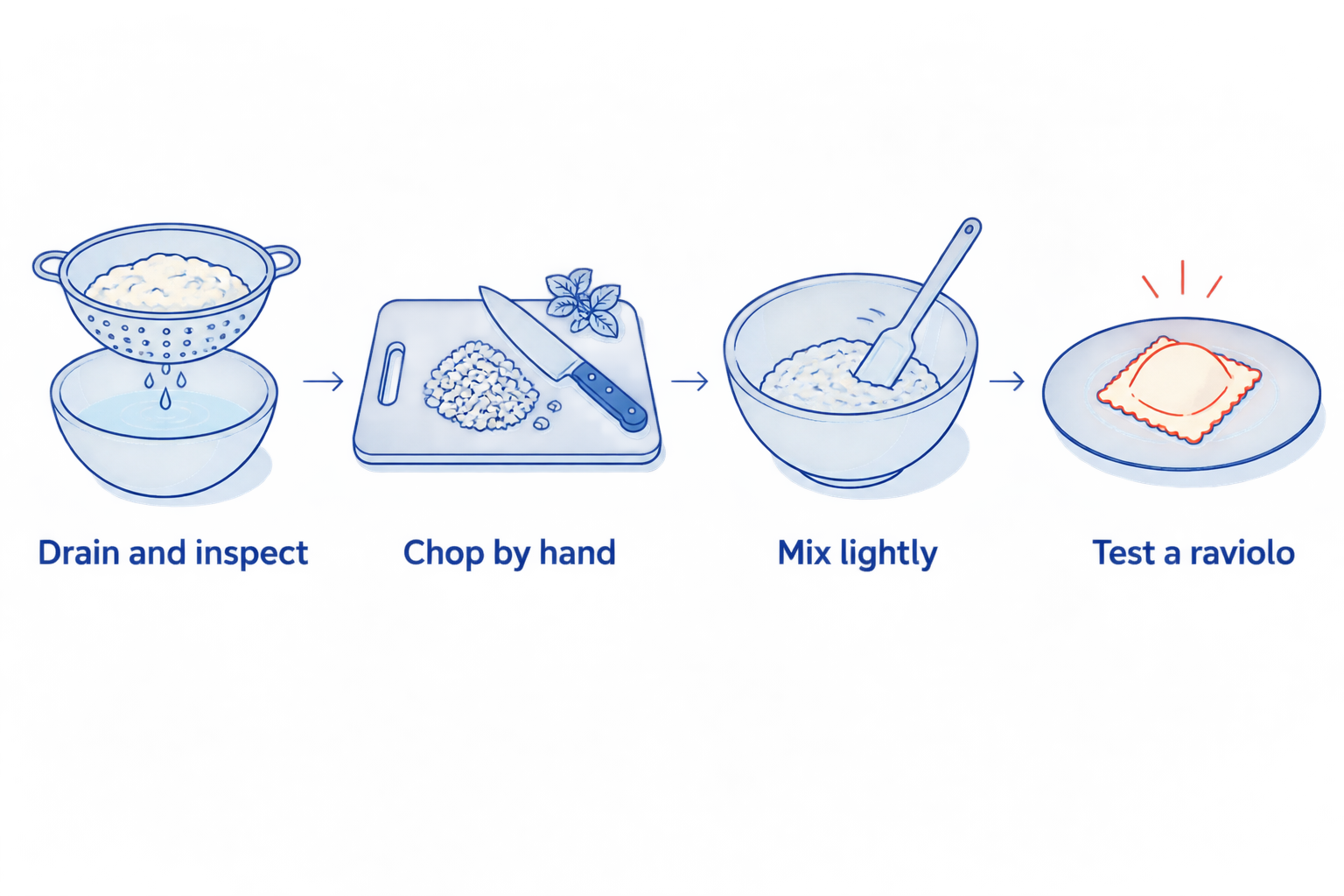
Good filling starts before you roll the dough. Finish preparing the lobster, cool cooked ingredients, and organize the filling components so the pasta does not sit uncovered while you work.
Drain and inspect
Follow the package's thawing instructions and keep seafood refrigerated. Check picked meat for stray shell fragments, then drain and gently blot surface moisture without squeezing the pieces dry.
Chop by hand
Use a knife to make small pieces that fit comfortably inside your chosen pasta shape. Hand chopping lets you stop before the lobster becomes a paste and helps you notice any remaining shell.
Mix lightly
Fold the lobster into your recipe's cooled filling ingredients. If using ricotta, drain it as the recipe directs; adding more cheese is not a substitute for managing excess liquid.
Test a raviolo
Fill, seal, and cook a sample before assembling the entire batch. Check that the filling stays inside, the seam holds, and the seasoning works with the sauce—not just on its own.
Order the right quantity and handle delivery safely
For a 2026 order, work backward from the recipe's required lobster meat weight. Convert units before comparing packages: 1 LB equals 16 oz, so a 2 LB package represents 32 oz before any draining or preparation losses.
Do not apply that calculation to shell-on tails as though every ounce were meat. For a smaller dinner, choosing a recipe first gives you a clearer shopping target than choosing a package and improvising the filling around it.
Before checkout, confirm:
- The selected individual-package or case quantity.
- Whether the lobster is raw or cooked, fresh or frozen.
- The cold-packing and delivery instructions for your destination.
- The storage instructions and space needed when the order arrives.
Inspect seafood promptly on arrival. Keep refrigerated seafood at 40°F or below, and do not leave perishable food at room temperature for more than 2 hours; that limit drops to 1 hour above 90°F. Follow package instructions for cooking, thawing, and storage rather than judging safety by smell alone.
How the 2026 picks are ranked
The ranking prioritizes explicit cooking status, shell-free preparation, suitability for chopping, and understandable package information. Cooked claw and knuckle meat ranks first because it removes both initial cooking and most shell handling from a recipe that calls for cooked lobster.
Broken cooked meat wins a separate slot for fine filling. Raw meat and tails remain useful options, but their additional preparation steps make them less direct choices for a first ravioli project.
Which lobster should you choose in 2026?
Choose Frozen Lobster Cooked Claw & Knuckle Meat if you are undecided. It is the simplest default for a recipe written around cooked lobster, with no need to buy whole lobsters for an ingredient you will chop.
Choose Cooked Broken Lobster Meat Frozen for a finer filling, or fresh cooked meat when that format fits your schedule. Onatru offers both meat and tail options; let the recipe determine which belongs in your kitchen.
FAQ
What's the best lobster for lobster ravioli?
Cooked claw and knuckle meat is the best default for lobster ravioli made with cooked lobster. It avoids initial cooking and shell picking, and you can chop it to suit the filling.
Is claw meat or tail meat better for lobster ravioli?
Picked claw and knuckle meat is the more direct choice for ravioli filling. Tail meat also works, but shell-on tails add preparation and do not provide their full weight as usable meat.
Can I use frozen lobster meat for homemade ravioli?
Yes, frozen lobster meat works for homemade ravioli. Follow the package's thawing instructions, confirm whether the meat is raw or cooked, and drain it before preparing the filling.
Should lobster be cooked before it goes into ravioli?
Cook the lobster first when your ravioli recipe calls for cooked lobster meat. Do not substitute raw lobster without a recipe that specifically accounts for safely cooking a raw seafood filling.
Is broken lobster meat good for ravioli filling?
Yes, cooked broken lobster meat suits ravioli filling because you will chop and enclose the pieces. It is less suitable when you want large, intact pieces for presentation.
How much lobster should I buy for ravioli?
Buy according to the cooked lobster meat weight specified in your recipe. Confirm package and case quantities, and do not treat shell-on tail weight as equivalent to picked-meat weight.
How do I keep lobster ravioli filling from getting watery?
Drain thawed lobster and gently blot surface moisture before mixing the filling. Drain other wet ingredients as the recipe directs, then cook a sample raviolo to check the result before finishing the batch.
One last thing
Test the filled pasta, not just the filling. A spoonful that tastes balanced on its own still needs to work inside dough and alongside sauce. One sample raviolo tells you whether to adjust seasoning, reduce the filling amount, or improve the seal before you assemble the rest.


