

When you buy shrimp online, choose by the complete ingredient list, your dietary needs, and the dish—not by whether an ingredient name sounds unfamiliar. Phosphates help retain moisture, sulfites help prevent discoloration, and salt affects seasoning; a phosphate-free claim does not mean the shrimp contains no other added ingredients.
- Buy shrimp online by comparing complete ingredient lists, not front-label claims alone.
- Choose shrimp-only ingredients when avoiding added salt, phosphates, and preservatives is your priority.
- Onatru lists a phosphate-free peeled shrimp option; check the complete label for other ingredients.
- Shrimp additives do not replace safe cold storage, thawing, or cooking.
Why this matters
Two bags of frozen shrimp can look similar while giving you different information about moisture retention, sodium, and preparation. Reading the back label helps you choose deliberately instead of treating every added ingredient as either harmless or a reason to reject the bag.
For your 2026 seafood orders, start with the ingredient statement and then check the product form. The guide to reading shrimp labels before ordering online covers the wider label check; this page focuses on what added ingredients mean in your kitchen.
Choose the shrimp that fits your needs, not the package with the most reassuring headline. A familiar-looking product name is not a substitute for the ingredient list.
How do you choose shrimp when the label lists added ingredients?
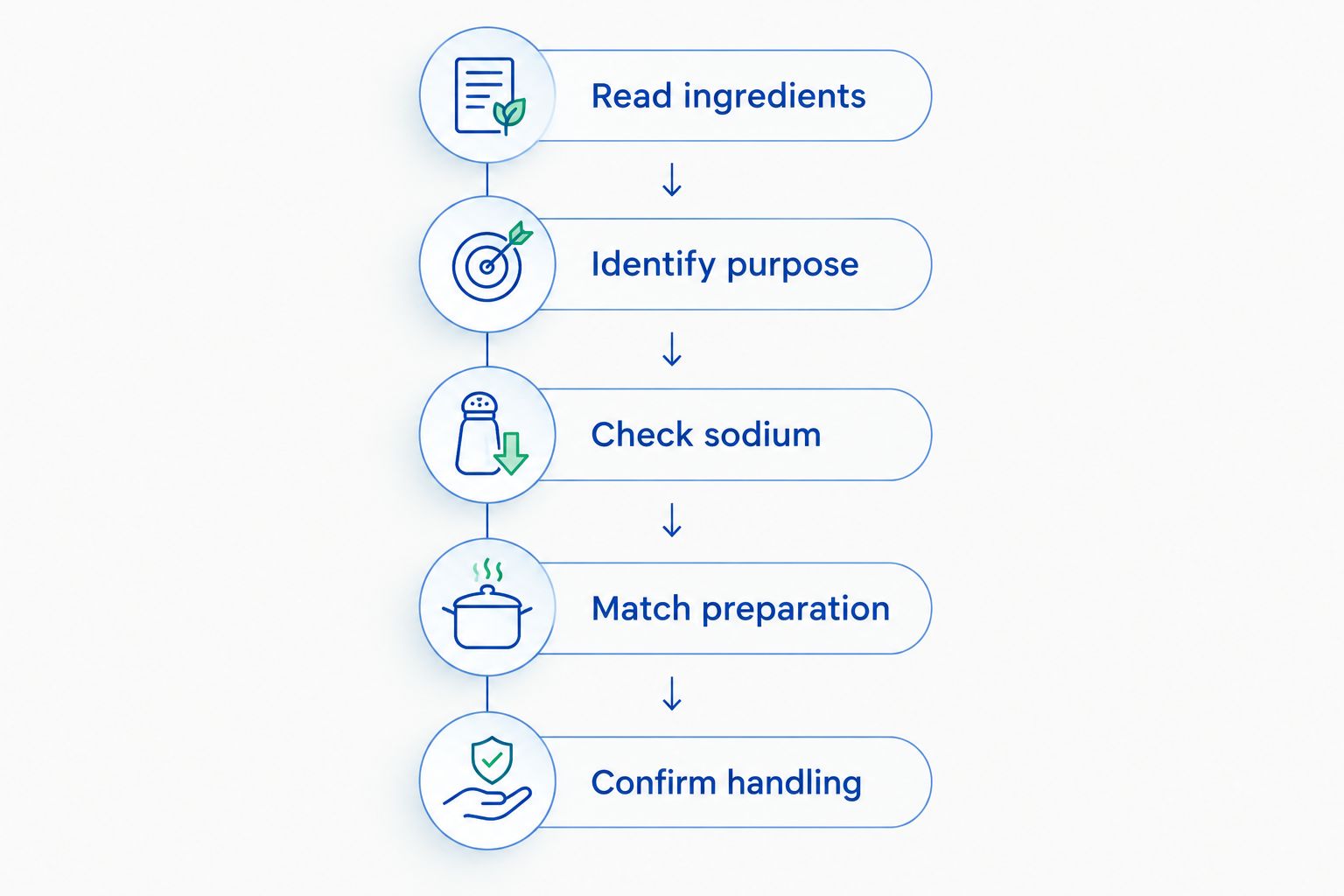
Use this sequence before adding shrimp to your cart. It separates ingredient questions from size, shell, and cooking questions so you can make a clear choice.
- Read ingredients. Look for the complete statement, not just the product title or a claim such as phosphate-free.
- Identify purpose. Separate moisture-retaining ingredients, discoloration treatments, and seasonings rather than treating them as interchangeable.
- Check sodium. Read the Nutrition Facts panel when sodium matters to your diet, comparing equivalent serving sizes.
- Match preparation. Confirm whether the shrimp is raw or cooked, peeled or shell-on, and tail-on or tail-off.
- Confirm handling. Review storage instructions and delivery-handling information before ordering.
If a listing gives only size and shell information, ask for a photograph of the ingredient statement and Nutrition Facts panel. An unanswered ingredient question is a reason to pause the purchase, not fill in the blanks.
Compare what the ingredient statement actually says
These are label categories, not claims about every shrimp product. A single package can include more than one of these ingredients, so read the whole statement.
| Label wording | What it tells you | Best for | Limitation or trade-off |
|---|---|---|---|
| Shrimp as the only ingredient | No other ingredient is declared | Cooks prioritizing a simple ingredient list | Does not establish origin, handling quality, or sustainability |
| Sodium tripolyphosphate or another phosphate | A phosphate treatment is declared; phosphates help retain moisture | Cooks comfortable with moisture-retaining treatment | Does not meet a preference to avoid added phosphates |
| Sodium bisulfite or sodium metabisulfite | A sulfite treatment is declared, commonly used against discoloration | Buyers without a sulfite restriction who accept this treatment | Unsuitable for someone instructed to avoid sulfites |
| Salt | Added salt is declared | Recipes where you can adjust other seasoning | Requires extra attention when limiting sodium |
| Water | Water is declared as an ingredient | Buyers comfortable with a product containing added water | The ingredient list alone does not quantify retained water |
Do not use this table as a ranking of safety or quality. A shorter ingredient list answers an ingredient-preference question; it does not answer every buying question.
What do phosphates in shrimp mean?
Phosphates, including sodium tripolyphosphate, help shrimp retain moisture. If avoiding that treatment matters to you, look for an explicit phosphate-free statement and check the complete ingredient list.
The advantage of choosing a clearly identified phosphate-free product is straightforward: it addresses that particular preference. The limitation is equally important: phosphate-free does not mean salt-free, sulfite-free, or shrimp-only.
For a 2026 shopping checklist, keep those claims separate. Do not expand one verified statement into several promises the label never makes.
Does phosphate-treated shrimp always cook badly?
No. A phosphate declaration does not tell you exactly how a particular bag will behave in your pan, and an ingredient list does not report the amount of moisture the shrimp will release during cooking.
For better browning, thaw shrimp safely, drain it, pat the surface dry, and avoid crowding the pan. Those steps address surface moisture and steam without pretending that preparation removes the treatment.
What do sulfites in shrimp mean?
Sulfites such as sodium bisulfite and sodium metabisulfite are used to help prevent dark discoloration known as melanosis. They serve a different purpose from phosphates, even though both can appear on seafood labels.
If you have a known sulfite sensitivity or have been told to avoid sulfites, use the ingredient statement and your clinician's guidance. Do not assume that cooking or rinsing makes a sulfite-treated product suitable for you.
Sulfite sensitivity and shellfish allergy are different concerns. Untreated shrimp is still shellfish, and a sulfite-free claim does not make shrimp safe for someone with a shellfish allergy.
Does darkening mean shrimp is spoiled?
Not necessarily: melanosis is a discoloration process, not by itself a spoilage diagnosis. The reverse also matters—an attractive color does not prove seafood was handled safely.
Judge an order using its temperature, packaging condition, storage instructions, and signs of spoilage together. Never use a preservative claim as evidence that a warm delivery is acceptable.
How should you compare salt, water, and sodium?
Salt in an ingredient statement tells you salt was added; the Nutrition Facts panel tells you the declared sodium per serving. Shrimp also contains naturally occurring sodium, so a shrimp-only ingredient list does not mean sodium-free.
Compare panels using the same serving weight and the same preparation state. A comparison between raw shrimp and a differently sized serving of cooked shrimp does not isolate the effect of an additive.
Added water and a protective ice glaze are also different concepts. Seeing ice on frozen shrimp does not establish its full ingredient statement, and a wet thawed surface does not identify which treatment was used.
For your 2026 comparison, record the actual words on each label rather than relying on memory. If you need a particular sodium limit, use the nutrition information and the portion you intend to eat—not the ingredient list alone.
Why shrimp ingredient lists vary
Ingredient lists reflect the product's formulation and preparation. These distinctions explain why comparing only the front of the bag leaves important questions unanswered:
- Moisture treatment: A phosphate-containing product declares a different formulation from one without added phosphates.
- Discoloration control: Sulfites address darkening rather than serving the same role as phosphates.
- Seasoning: Salt and other seasonings change both the ingredient statement and how you season your dish.
- Prepared format: Breaded or sauced shrimp includes ingredients beyond those in plain shrimp, so check allergens and cooking directions too.
- Specific label claims: Phosphate-free describes one exclusion; it does not describe every ingredient or processing step.
None of these distinctions tells you the catch location or certifies responsible sourcing. Read origin and certification information separately when those factors guide your purchase.
Which listed shrimp options fit different home-kitchen needs?
Onatru is a fit for home cooks seeking restaurant-quality shrimp ingredients delivered nationwide. Choose a specific product by its verified description, then confirm the full package label before treating it as suitable for an ingredient restriction.
The supplied descriptions distinguish these two options by preparation and one explicit treatment claim. They do not establish a complete ingredient comparison.
| Product | Best for | Verified useful detail | What still needs checking |
|---|---|---|---|
| Shrimp 13-15 White Peeled and Deveined Tail On | Cooks seeking peeled shrimp with a stated phosphate-free description | Described as raw, frozen, tail-on, peeled, and phosphate-free | Complete ingredients, sodium, and any other treatment |
| White Ecuadorian Shrimp Shell On U/15 Head Off | Cooks who want shell-on, head-off shrimp | Shell-on and head-off form stated in the title | Complete ingredients and treatment status; peeling adds preparation |
Onatru's supplied 2026 product information supports the phosphate-free description for the peeled option, not for every shrimp listing. Shell-on is a preparation format, not evidence that a product is untreated.


When browsing Onatru, ask about the exact product you intend to order. A detail verified for one bag should not become an assumption about the whole seafood selection.
Can you rinse added ingredients off shrimp?
Do not treat rinsing as a way to turn treated shrimp into untreated shrimp. A rinse does not verify removal of phosphates, sulfites, or added sodium, and it does not create a new ingredient statement.
If avoiding an ingredient is essential, buy a product whose documented formulation meets that need. For ordinary cooking preparation, follow the package instructions and dry thawed shrimp before sautéing rather than trying to wash away an uncertain treatment.
Does a simple ingredient list make shrimp safer?
No: ingredient simplicity does not replace temperature control or proper cooking. FDA consumer seafood guidance recommends refrigerator storage at 40°F or below, keeping perishable seafood out of refrigeration for no more than 2 hours under ordinary conditions, and cooking most seafood to 145°F.
These are general food-safety reference points, not product-specific shipping promises. The FDA's time limit is shorter in conditions above 90°F, and package-specific instructions still matter.
For a 2026 home delivery, plan to receive and inspect the package promptly. Check the seafood itself and follow safe handling guidance; cold-pack materials alone do not establish that the food arrived at a safe temperature.
FAQ
What should I check first when I buy shrimp online?
Check the complete ingredient statement first, then confirm whether the shrimp is raw or cooked and peeled or shell-on. Product titles and front-label claims do not answer every ingredient question.
Is phosphate-free shrimp the same as shrimp with no additives?
No, phosphate-free shrimp is not automatically free of other added ingredients. Read the complete statement for salt, sulfites, water, or other declared ingredients.
Are sulfites and phosphates the same thing in shrimp?
No, sulfites and phosphates serve different purposes in shrimp. Sulfites help prevent discoloration, while phosphates help retain moisture.
Can I remove shrimp additives by rinsing?
Rinsing does not reliably make treated shrimp equivalent to untreated shrimp. Choose a documented ingredient list that meets your needs rather than relying on rinsing.
Does wild-caught shrimp always have fewer added ingredients?
No, wild-caught describes how shrimp was harvested, not its complete formulation. Check the ingredient statement separately for any added treatments.
Which Onatru shrimp description mentions phosphate-free?
Shrimp 13-15 White Peeled and Deveined Tail On is described as phosphate-free in the supplied product information. Confirm the complete current label for other ingredients and nutrition details.
What temperature should my refrigerator be for shrimp?
40°F or below is the FDA's refrigerator-storage recommendation for seafood. Keep shrimp properly chilled and follow the package's storage instructions.
One last thing
Before your next order, save a photograph of the package's ingredient statement alongside the product name. That gives you a useful reference when reordering in 2026 without assuming that a familiar title proves an unchanged formulation.
Buy for the ingredient list you can verify, then cook for the dish you want. You do not need to fear an unfamiliar word; you need to know what it means for your meal.


