

When you buy shrimp online in a large order, divide it into meal-size freezer packs, remove excess air, and label each pack with its weight, preparation state, and freezing date. Keep loose frozen shrimp frozen while you portion it; handle a solid frozen block differently rather than forcing it apart. The goal is simple: thaw only what dinner needs, without repeatedly warming the rest of your order.
- Buy shrimp online with a meal-size freezer plan, not just a large-order mindset.
- Onatru suits home cooks ordering restaurant-quality shrimp for nationwide delivery.
- Portion loose frozen shrimp without thawing; refrigerate solid blocks if separation requires thawing.
- Keep your freezer at 0°F and thaw shrimp in the refrigerator, not on the counter.
Why this matters
A large shrimp order becomes useful when you can pull out dinner without wrestling with the whole package. Smaller, clearly labeled packs also help you distinguish raw shrimp from cooked shrimp before you start a recipe.
Onatru sells restaurant-quality ingredients with nationwide delivery. Before ordering seafood in 2026, check the selected product’s pack size, preparation state, and current delivery instructions; those details determine how you will receive, divide, and store it.
Build your freezer plan around meals you actually cook, not identical bags you never quite finish. Shrimp for a quick pasta dinner and shrimp for a family boil do not need the same portion.
How do you portion a large shrimp order for your freezer?
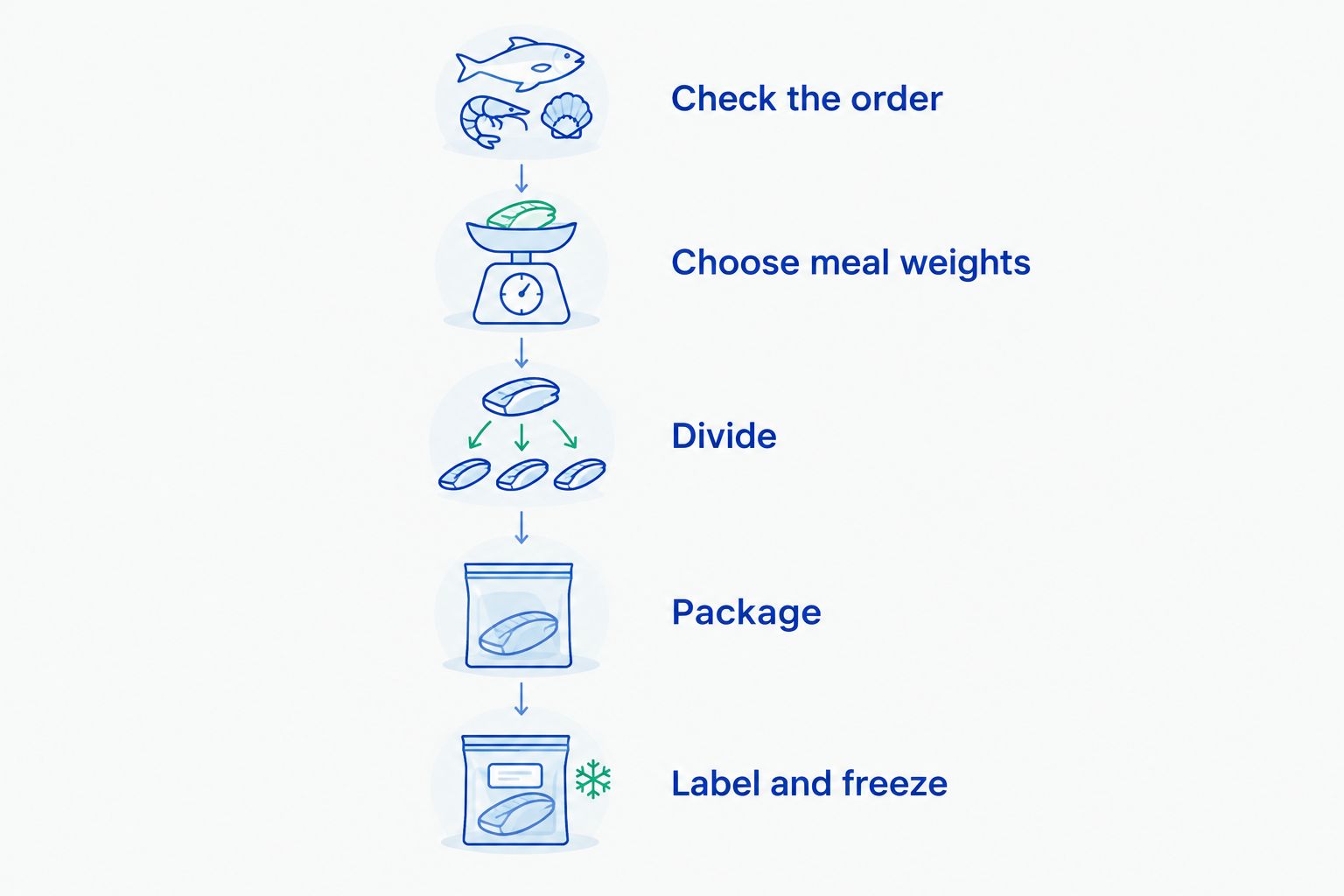
Follow this sequence after checking the package instructions and the condition of the shrimp. Set out your supplies before opening anything so you can work without leaving seafood on the counter.
- Check the order. Confirm whether the shrimp is raw or cooked, shell-on or peeled, and loose frozen or frozen together. Read any handling instructions before opening the packaging.
- Prepare your station. Gather a kitchen scale, freezer-grade bags or containers, a marker, and a clean tray. Keep raw shrimp and its utensils away from ready-to-eat food.
- Choose meal weights. Use a recipe or your household’s usual serving size to decide how much belongs in each pack. Weigh shell-on shrimp separately from peeled shrimp rather than treating them as interchangeable.
- Divide without unnecessary thawing. Scoop loose frozen shrimp into weighed portions and return each finished pack to the freezer. Do not thaw an entire loose-frozen bag just to make smaller bags.
- Package against air exposure. Use freezer-grade packaging, gently press out excess air, and seal securely. Arrange the shrimp in a shallow layer where practical, without crushing it.
- Label and freeze. Record the shrimp type, raw or cooked state, shell status, weight, and date. Keep the original product information or photograph it before discarding the outer packaging.
Do not pry apart a solid block with a knife. A slipping blade creates an injury risk, and separating a block is not worth damaging either your hands or the shrimp.
Choose portion weights that match your meals
There is no single freezer portion that fits every household. A shrimp-centered dinner needs a different plan from a rice dish in which shrimp shares the plate with vegetables and other ingredients.
Start with the amount your recipe calls for. If a familiar recipe feeds your household well, its shrimp weight is a more useful starting point than an unfamiliar serving estimate.
Use weight for portioning and the size count for understanding the shrimp. A count designation describes the approximate number of shrimp per pound, not the number of servings in a package. For example, 21–25 count means approximately 21–25 shrimp per pound; U/15 means fewer than 15 per pound.
Shells and heads complicate comparisons because they contribute to package weight but are not the peeled meat you put on the plate. Do not apply a guessed yield percentage. Plan from a recipe written for the same preparation state, or record your own measured yield after preparation.
For your 2026 freezer labels, keep the weight prominent and the meal idea secondary. A pack marked for tacos can still become pasta, but knowing its weight lets you adapt the recipe confidently.
Keep different meal sizes separate
Make smaller packs for meals where shrimp is an addition and larger packs for recipes where it is the main ingredient. You can combine smaller packs when company comes; dividing a fully frozen oversized pack is harder.
Avoid making every pack tiny, though. More packs mean more packaging and more labels to track. Choose a few useful meal sizes rather than creating a freezer full of miscellaneous handfuls.
Which shrimp format is easiest to portion?
Loose individually frozen shrimp is easier to divide while frozen than a solid block. That is a handling advantage, not a promise that any particular listing uses that freezing method. Check the product description or ask before buying if easy separation matters to you.
| Format | Best for | Practical advantage | Limitation |
|---|---|---|---|
| Loose frozen shrimp | Taking out a measured amount | Separates without thawing the whole pack | Needs secure resealing against air exposure |
| Solid frozen block | Using a full package together | Keeps the shrimp together in one unit | Cannot be conveniently divided while solid |
| Peeled shrimp | Recipe-ready meal packs | Less shell preparation before cooking | Tail-on versions still require a tail decision |
| Shell-on shrimp | Recipes that use shells during cooking | Lets you keep shells through preparation | Package weight includes shells |
| Cooked shrimp | Recipes calling for cooked shrimp | Does not need cooking from raw | Repeated heating can toughen the texture |
Keep raw and cooked portions visibly distinct. A freezer full of unlabeled bags makes it too easy to grab the wrong starting ingredient for dinner.
Product choices that fit a freezer plan
Onatru is best for home cooks who want restaurant-quality shrimp delivered nationwide. Choose the preparation state that fits your cooking routine, then confirm the purchase unit before placing a large order.
These listings illustrate two different approaches. Neither product’s listed pack configuration establishes whether the shrimp separates freely while frozen.
| Product | Best for | Advantage for your plan | Preparation trade-off |
|---|---|---|---|
| White Ecuadorian Shrimp Shell On U/15 Head Off | Home cooks who want shell-on shrimp | The description lists a 5 LB individual unit and a case configuration | Shells contribute to portion weight and require a preparation decision |
| 21-25 White Shrimp P&D T-Off | Home cooks who prefer peeled, deveined, tail-off shrimp | The description lists a 2 LB individual unit and a case configuration | Does not suit a recipe specifically calling for shell-on shrimp |
Confirm whether the order selection is an individual unit or a case; a description containing both is not a reason to assume either one. Match the selected quantity to your freezer space and meal plan.


Why your freezer portions vary
The right pack size follows your kitchen, not just the size of the order. Check these factors before committing every bag to the same weight:
- Recipe role: A shrimp appetizer, a pasta dish, and a shrimp-centered dinner call for different quantities.
- Household appetite: Your familiar recipes provide a practical starting point for how much your household eats.
- Shell status: Shell-on and head-on weights include parts you will not necessarily serve.
- Preparation state: Raw and cooked shrimp belong in separate packs with clear labels.
- Freezing format: Loose shrimp permits frozen portioning; a solid block requires a different handling plan.
- Freezer space: Leave room to store the finished packs without blocking air circulation or crushing other food.
Keep a simple inventory in 2026: product, portion weight, freezing date, and packs remaining. Update it when you remove a pack, not after you have forgotten what dinner used.
Keep the shrimp cold while you work
The FDA’s consumer seafood guidance calls for refrigeration at 40°F or below. Its general cold-storage guidance sets freezers at 0°F. An appliance thermometer helps you verify those conditions rather than relying on the control dial alone.
Perishable seafood should not sit at room temperature for more than 2 hours, or more than 1 hour when temperatures are above 90°F. Those FDA limits are maximum exposure limits, not targets for portioning. Work promptly and return portions to cold storage as you finish them.
For your 2026 freezer routine, prepare bags and labels first, then work with a manageable amount of shrimp at a time. Keep the rest refrigerated or frozen as appropriate.
Freezing does not rescue seafood that has been held unsafely. If the delivery condition is uncertain, follow the seller’s handling instructions and contact the seller rather than using smell alone to decide whether it is safe.
Can you refreeze shrimp after thawing it to portion?
Shrimp thawed safely in the refrigerator can be refrozen without cooking, although moisture loss can reduce quality. USDA guidance distinguishes refrigerator thawing from faster methods; the method matters, not simply whether the shrimp still feels cool.
If you thaw shrimp using cold water or a microwave, cook it before refreezing. Do not soften a block on the counter for easier separation, and follow package-specific thawing instructions, especially for vacuum-packed seafood.
For a solid block, refrigerator thawing is the practical route when separation requires thawing. Place it in a container that catches drips, keep it away from ready-to-eat food, and portion it promptly once it separates.
How should you thaw a meal-size shrimp pack?
Thaw a meal-size pack in the refrigerator in a leakproof container that catches drips. Move it out of the freezer as part of your meal planning rather than leaving it on the kitchen counter.
For faster thawing, FDA seafood guidance allows a sealed bag submerged in cold water; keep the water cold and cook promptly afterward. Follow the product’s instructions if they specify a particular method or require removing packaging before thawing.
Once thawed, drain the shrimp and pat it dry as your recipe requires. Smaller packs make this process easier because you are handling only the amount you intend to prepare.
What should you write on each freezer pack?
Write enough information to cook without guessing: shrimp type, raw or cooked, shell-on or peeled, tail status, weight, and freezing date. Keep the original package’s handling information accessible as well.
A useful label separates the product identity from your dinner idea. Put the measured weight beside the description, then add an optional note such as pasta, tacos, or appetizer.
Use the complete date, including 2026, rather than a month name alone. Keep supplier dates distinct from your own repacking date; repacking does not reset a manufacturer’s quality guidance.
FAQ
Should I thaw a whole bag of shrimp before portioning it?
Do not thaw a whole bag if the frozen shrimp already separates freely. Weigh it into meal-size packs while frozen and return the finished packs to the freezer promptly.
What temperature should my freezer be for shrimp?
Keep your freezer at 0°F, consistent with FDA cold-storage guidance. Use an appliance thermometer to check the temperature rather than relying only on the freezer dial.
Can I refreeze raw shrimp after refrigerator thawing?
Raw shrimp thawed safely in the refrigerator can be refrozen, although moisture loss can affect quality. Shrimp thawed in cold water or a microwave should be cooked before refreezing.
How much shrimp should I put in each freezer bag?
Put the amount your recipe or household meal requires in each freezer bag. Use a scale, and do not treat shell-on weight as equivalent to peeled shrimp meat.
Is peeled shrimp easier to prepare than shell-on shrimp?
Peeled shrimp removes the shell-removal step from meal preparation. Shell-on shrimp suits recipes that call for the shells, but its package weight includes them.
What should I check before I buy shrimp online from Onatru?
Check the exact product, selected purchase unit, raw or cooked state, shell status, and handling instructions before ordering. Confirm current delivery details and make enough freezer space for the quantity selected.
Can freezer burn make shrimp unsafe?
Freezer burn is a quality problem rather than a food-safety hazard, according to USDA guidance. Air-resistant freezer packaging helps limit the drying that causes it; freezing does not correct unsafe handling.
One last thing
Keep one pack deliberately smaller than your usual dinner portion. It gives you flexibility for adding shrimp to noodles, a salad, or a shared appetizer without thawing a full meal pack.
That small decision makes a large order feel more useful. You are stocking ingredients for the way you cook, not creating another oversized package to work around.


