Yes, you can buy frozen bread dough and bake it into fresh bread at home; choose raw yeast dough when you want the final rise and baking to happen in your kitchen. The catch is preparation: frozen dough is not necessarily ready to bake, and the package instructions determine whether you must thaw, shape, or proof it first.
- Can you buy frozen bread dough? Yes—choose raw yeast dough for bread you proof and bake at home.
- Par-baked bread needs finishing, while fully baked frozen bread needs reheating; neither is raw bread dough.
- Follow the package’s thawing, proofing, and baking instructions rather than a universal timetable.
- Onatru serves home cooks seeking restaurant-quality ingredients delivered nationwide; check each listing for its exact preparation requirements.
Can you buy frozen bread dough that bakes like fresh?
Yes—raw frozen yeast dough lets you bake bread fresh without mixing and kneading it yourself. Freezing pauses the process; proper thawing and proofing prepare the dough for baking. The finished texture still depends on the dough formula, storage, handling, and oven.
For your 2026 shopping list, distinguish these formats before comparing package sizes. If bread is part of a seafood dinner, start with the meal: this guide to pairing lobster with fresh bread helps connect the loaf to what you are serving.
| Bread format | Best for | Main advantage | Main limitation |
|---|---|---|---|
| Raw frozen yeast dough | Home cooks who want to proof and bake bread | Removes mixing and kneading while keeping the final bake at home | Requires the specified thawing and rising process |
| Par-baked frozen bread | Home cooks who want to finish a loaf in the oven | Partially baked structure is already established | Offers less shaping flexibility than raw dough |
| Fully baked frozen bread | Home cooks who mainly want to warm bread for serving | No raw-dough proofing step | Reheating is not the same process as baking raw dough |
These are different levels of preparation, not a quality ranking. Choose the format that fits your schedule rather than assuming the least-prepared option always makes the best dinner.
Why this matters
The phrase frozen bread does not tell you what happens after you open the package. A photograph of a browned loaf describes the intended result, not necessarily what arrives in the box.
That distinction matters when you are cooking the rest of dinner. Raw yeast dough needs a preparation window; par-baked and fully baked bread follow different finishing instructions. Match the bread’s preparation requirements to your evening before you order.
Raw frozen yeast dough: best for a home-baked loaf
Choose raw frozen yeast dough when you enjoy the final stages of bread-making but want to skip measuring, mixing, and kneading. Depending on the product, you will thaw it, shape it, let it rise, and bake it according to the label.
The benefit is participation without starting from scratch. You get to watch the dough expand and bake the loaf in your own oven. The trade-off is that yeast dough responds to conditions, so a rigid dinner deadline is less forgiving than a flexible afternoon.
Check whether the dough arrives as a shaped loaf, individual portions, or a piece you must shape. Do not assume every frozen dough works equally well for sandwich bread, dinner rolls, or pizza; use the applications the manufacturer specifies.
Par-baked bread: best for finishing rather than proofing
Choose par-baked bread when you want to finish bread in the oven without managing a raw dough’s final rise. The bread has already undergone part of its baking process, and your oven completes the manufacturer’s intended preparation.
This format suits a meal where you want to focus on the main course. Its limitation is flexibility: a partially baked loaf is not a blank piece of dough you can reshape into rolls.
For a 2026 dinner-party plan, read the finishing instructions before deciding when the bread goes into the oven. Some products require a particular handling method, and directions for one loaf do not transfer automatically to another.
Fully baked frozen bread: best for simple warming
Choose fully baked frozen bread when your priority is serving bread rather than baking raw dough. Follow the package directions for thawing or warming, then serve it with the meal.
The advantage is a simpler process. The limitation is that reheating cannot reverse poor storage or turn an unsuitable bread style into the loaf you wanted.
Think about how you will use it. Bread for toast, sandwiches, or dipping has different practical requirements, even when all of it starts in the freezer. Decide on the meal first, then choose the format and loaf style.
Why frozen bread dough results vary
Frozen dough is a starting point, not a promise that every loaf will behave identically. These factors explain why the instructions matter:
- Dough formula: Lean dough and dough enriched with ingredients such as milk, eggs, or fat behave differently during preparation and baking.
- Storage conditions: Damaged packaging and exposure to freezer air can dry the surface and reduce eating quality.
- Thawing method: The dough must reach the condition specified by the manufacturer before the next stage.
- Proofing: Underproofed and overproofed dough produce different loaf structures; follow the product’s stated readiness cues.
- Shape and pan: A loaf, roll, and free-standing shape do not bake identically. Use the specified pan or approved shaping method.
- Oven conditions: An oven that runs hotter or cooler than its setting changes the bake. An oven thermometer helps you check the actual temperature.
Do not fix a slow rise by applying uncontrolled heat. Follow the label’s proofing method rather than placing dough against a heater or into an oven that is too hot.
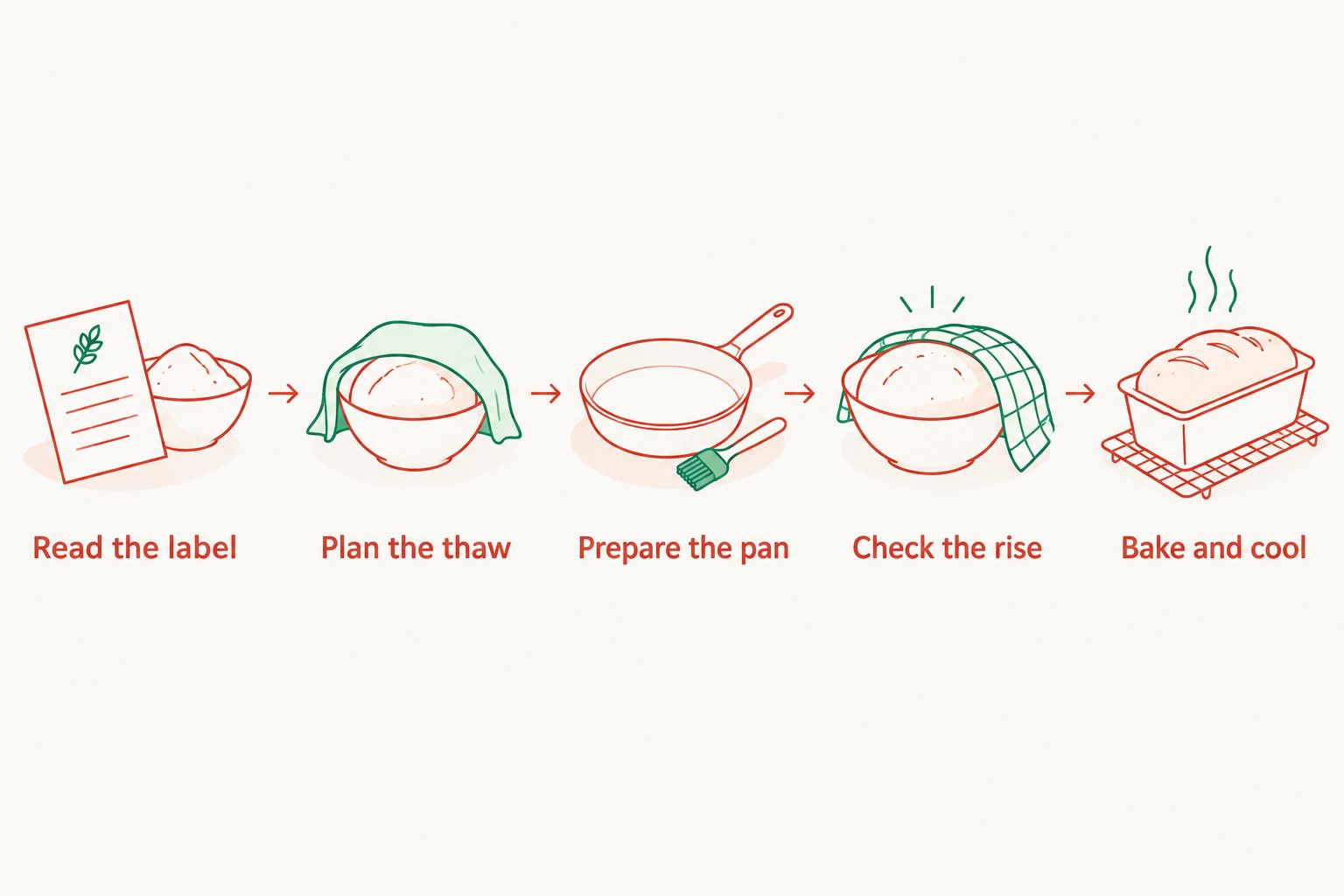
How do you bake frozen bread dough successfully?
For a dependable 2026 baking routine, work from the package backward: identify the baking directions, the proofing requirements, and the thawing method before you begin. Keep the label until the bread is finished.
- Read the label. Confirm that the product is raw yeast dough, then check ingredients, allergens, storage requirements, and preparation directions.
- Plan the thaw. Use the specified method. Protect the dough from drying out as directed, and allow for the full preparation sequence.
- Prepare the pan. Use the pan size and preparation method on the package. Shape only when the directions call for it.
- Check the rise. Look for the manufacturer’s stated visual or physical cues rather than treating elapsed time as the only test.
- Bake and cool. Preheat as instructed, follow the baking directions, and let the loaf cool enough for its crumb to set before slicing.
The order matters. A browned exterior alone does not establish that a loaf is baked through, and slicing immediately can make the interior seem gummy even after baking.
What should you check before ordering frozen dough online?
Buy from the product description, not the finished-loaf photograph. A useful listing identifies what the product is, how much you receive, how to store it, and how to prepare it.
Use this 2026 ordering checklist before committing freezer space:
- Product state: Look for an explicit description of raw dough, par-baked bread, or fully baked bread.
- Preparation instructions: Confirm whether thawing, shaping, and proofing are required.
- Package quantity: Distinguish the number of pieces from the total net weight and any outer-case quantity.
- Ingredients and allergens: Check the actual label, especially when serving guests with dietary restrictions.
- Delivery handling: Read the seller’s frozen-food shipping information and instructions for inspecting the order.
- Freezer fit: Check package dimensions when provided and make room before delivery.
Onatru is best for home cooks seeking restaurant-quality ingredients delivered nationwide. For a bread-dough purchase, confirm the exact product format and preparation directions rather than treating a general bakery category as proof that an item is raw frozen dough.
A broad ingredient selection helps you plan a meal, but it does not replace item-level details. If a listing leaves the preparation method unclear, ask before ordering.
How should you store frozen bread dough at home?
Keep frozen bread dough at 0°F (-18°C) or below, consistent with FDA home-freezer guidance. Protect the original packaging from damage and follow the manufacturer’s storage and quality instructions.
For refrigerated thawing when the label specifies it, keep your refrigerator at 40°F (4°C) or below, consistent with FDA refrigerator guidance. Refrigerator and freezer temperatures serve different purposes; neither tells you how long a particular dough needs to rise.
Label the package with your purchase date so you can use older items first. Keep the preparation panel with any portions you separate, and do not assume a tightly sealed container eliminates the need to follow storage instructions.
Treat raw dough as raw food. FDA guidance warns against tasting uncooked dough because flour is a raw ingredient, and some dough also contains raw eggs.
Can frozen bread dough taste as good as homemade?
Frozen bread dough can produce an enjoyable freshly baked loaf, but it is not automatically identical to your homemade recipe. Flour, fermentation, enrichment, and handling influence flavor and texture.
Decide what matters most to you: a soft sandwich crumb, a crusty dinner loaf, or individual rolls. Then choose a product intended for that use and follow its directions before experimenting.
Do you have to thaw frozen bread dough before baking?
Raw frozen yeast dough often requires thawing and proofing, but the package determines the method. A product explicitly designed to bake from frozen follows a different process.
Do not substitute instructions from par-baked bread for raw dough. They begin at different stages of preparation, even when their finished photographs look similar.
Can you make rolls from a frozen loaf of dough?
Use frozen loaf dough for rolls only when the manufacturer supports dividing and reshaping it. Follow the specified stage for handling the dough and the instructions for the new shape.
Dividing dough changes the size and geometry of each piece, so the loaf’s baking directions are not automatically appropriate. If individual rolls are your main goal, dough sold for rolls removes that uncertainty.
FAQ
Can you buy frozen bread dough instead of making it from scratch?
Yes, you can buy raw frozen bread dough to skip mixing and kneading. Check whether the product requires thawing, shaping, and proofing before baking.
What’s the best frozen bread format if I don’t want to wait for dough to rise?
Par-baked or fully baked frozen bread is a better fit when you want to avoid managing a raw dough’s final rise. Follow the package’s finishing or warming directions.
Is frozen bread dough the same as frozen bread?
No, frozen bread dough is unbaked, while frozen bread can be partially or fully baked. The product state determines what preparation remains.
Why didn’t my frozen bread dough rise?
Incorrect thawing, unsuitable proofing conditions, or weakened yeast are possible causes of poor rise. Check the storage history and package directions before changing the method.
Can I leave frozen bread dough on the counter overnight?
Use an overnight counter thaw only if the manufacturer explicitly directs that method. Do not improvise a long room-temperature thaw, especially for dough containing perishable ingredients.
Can I bake frozen bread dough in an air fryer?
Use an air fryer only when the product provides suitable instructions or the manufacturer confirms the method. A loaf’s oven directions do not automatically translate to an air fryer.
What should I check when shopping for bread ingredients at Onatru?
Check the exact product description, ingredients, package quantity, storage directions, and preparation method. A bakery item is not necessarily raw frozen bread dough.
One last thing
Plan the cooling time, not just the baking time. Bread continues to set after it leaves the oven; cutting too soon can compress the crumb and leave a misleading impression of underbaking.
For your first loaf in 2026, keep the toppings simple and follow the package before making changes. A successful first bake gives you a useful baseline for the next one—without overcomplicating dinner.