

Instead of shopping for meat and seafood separately, build your surf and turf meat and shrimp order around one menu, a portion worksheet, and a delivery-day storage plan. Start with Onatru for restaurant-quality ingredients shipped nationwide, then choose products you can portion, prepare, and serve together without rushing.
- Build your surf and turf meat and shrimp order around portions, package weights, and separate cooking steps.
- Onatru suits home cooks ordering restaurant-quality meat and seafood for nationwide delivery.
- Choose raw peeled shrimp for skillet dinners; cooked lobster meat offers a different preparation workflow.
- Confirm each-versus-case quantities before ordering, and reserve refrigerator and freezer space before delivery.
Why this matters
A surf and turf dinner works best when the order matches the cooking plan. A large meat package and a case of shrimp are ingredients for several meals, not automatically a ready-to-cook dinner box.
Onatru is best for home cooks who want restaurant-quality meat and seafood delivered nationwide. The trade-off is planning: you still need to check package quantities, distinguish raw from cooked seafood, and coordinate thawing and preparation.
For your 2026 dinner plan, treat “box” as the collection you assemble rather than the name of a preset bundle. Choose the meal first, then buy the ingredients that support it.
Before you start
- Have the ordering essentials ready: your delivery address, access to current product information, and the shipping instructions presented with your order. Confirm the delivery arrangements before tying the meal to a particular evening.
- Prepare your kitchen: clear refrigerator and freezer space, find a food thermometer and kitchen scale, and gather separate containers and utensils for raw meat and seafood.
- Catch the package-size gotcha: descriptions can show both EACH and CASE quantities. A listing that mentions individual packs and a multipack case does not, by itself, settle which quantity you are selecting.
Do not plan from the product photo alone. Read the title, selected quantity, net weight, storage directions, and raw-or-cooked designation before you commit.
Menu and portion worksheet
Set your dinner portions
- Write down the guest count. Separate the number of people eating beef from the number eating shellfish. Ask about shellfish allergies before building a shared menu.
- Choose the plate format. Decide whether the meat and shrimp share the main course or whether seafood becomes a starter. This determines how much of each ingredient you need.
- Set your own portion targets. As an example worksheet—not a universal serving rule—plan 6 ounces of boneless raw beef and 3 ounces of raw peeled shrimp per adult, then adjust for appetites and sides.
- Multiply before choosing packages. For 4 adults, that example requires 24 ounces of beef and 12 ounces of peeled shrimp. Record those amounts separately from the quantity you intend to purchase.
- Assign the remainder. Write a second meal beside any surplus: beef bowls, shrimp pasta, or another surf and turf dinner. Only count on portioning a frozen package if its format allows it safely.
Expected result: a shopping worksheet that distinguishes dinner portions from total package weight. You know what the first meal uses and what needs storage.
Shell-on weight is not interchangeable with peeled shrimp weight. Shells and heads contribute to the purchased weight but do not become the same amount of plated meat; avoid applying the peeled-shrimp example directly to a head-on product.
Match the ingredients to your cooking method
Use the following comparison to choose preparation, not just appearance. These are different ingredients with different jobs; lobster is an optional replacement or addition, not a requirement for shrimp surf and turf.
| Ingredient | Best for | Practical advantage | Limitation |
|---|---|---|---|
| Beef Chuck Flap Meat (Choice) | Sliced beef served beside shrimp | Boneless chuck flap can be prepared and sliced for individual plates | It is not a pre-portioned steak; check the grain and plan your cutting method |
| Shrimp 13-15 White Peeled and Deveined Tail On | A skillet-cooked seafood main | Peeling and deveining are already done; the description identifies the shrimp as raw and frozen | Tail shells remain, and the shrimp still require safe thawing and cooking |
| Cooked 16-20 White Shrimp P&D T-On | A chilled shrimp starter | The title identifies cooked, peeled-and-deveined shrimp | It does not follow the same cooking sequence as raw shrimp; tail shells remain |
| Frozen Lobster Cooked Claw & Knuckle Meat | A lobster variation without shell removal | The description identifies steam-cooked claw and knuckle meat stored frozen | It requires thawing and careful handling rather than another full raw-seafood cook |
For a first attempt, choose one meat and one seafood preparation. Adding both shrimp and lobster introduces another handling task without solving the main challenge: getting dinner to the table together.
Product and order checks
Confirm the exact packages
- Read the full product title. Look for peeled, shell-on, tail-on, raw, cooked, and frozen. These words determine your preparation work.
- Confirm the purchase unit. For Beef Chuck Flap Meat (Choice), the supplied description lists EACH as a 5.0-pound average and CASE as fourteen of those average-weight units. Verify the selected unit rather than assuming either applies.
- Check seafood quantities separately. Shrimp 13-15 White Peeled and Deveined Tail On lists a 2-pound EACH pack and a case of five 2-pound packs. Confirm which purchase unit your order uses.
- Read the ingredient and handling information. Check anything relevant to allergies, added ingredients, or your recipe. Do not infer a sourcing certification or production method from a photograph.
- Review delivery and receiving instructions. For your 2026 order, use the current shipping details presented by Onatru. Confirm cold-packed handling instructions without assuming a particular coolant, transit speed, or arrival date.
Expected result: your order record identifies the actual purchase unit, product form, and storage needs. The quantity in the order matches your worksheet or has an intentional surplus plan.
These products illustrate the meat-and-shrimp pairing and an optional lobster variation. Choose according to your menu and confirmed package unit, not because all belong in the same order.


Receiving and dinner preparation
Organize your delivery-day storage
- Inspect promptly. Check package condition, product temperatures, and the supplied handling directions before putting ingredients away. Cold packing does not replace checking the food itself.
- Use temperature rather than touch alone. USDA mail-order food guidance says perishable deliveries should arrive frozen, partially frozen with ice crystals, or refrigerator-cold at 40°F or below. Do not taste questionable food to decide whether it is safe.
- Store by product instructions. Keep refrigerated perishables at 40°F or below and your freezer at 0°F. Place raw ingredients in leakproof containers below ready-to-eat food.
- Label your meal portions. Use the product name, raw or cooked status, intended meal, and actual packing date. Include 2026 on this year's labels so an older portion cannot blend into a later freezer cleanout.
- Keep uncertain deliveries separate. If perishable food arrives above 40°F, do not eat it; contact the seller about the delivery. A normal smell does not establish safety.
Expected result: every ingredient has a safe storage location, and your dinner portions are distinguishable from food reserved for later meals.
Keep the receiving sequence simple: Inspect, Store, Thaw, then Cook. Complete each stage before moving to the next, rather than leaving the entire delivery on the counter while organizing dinner.
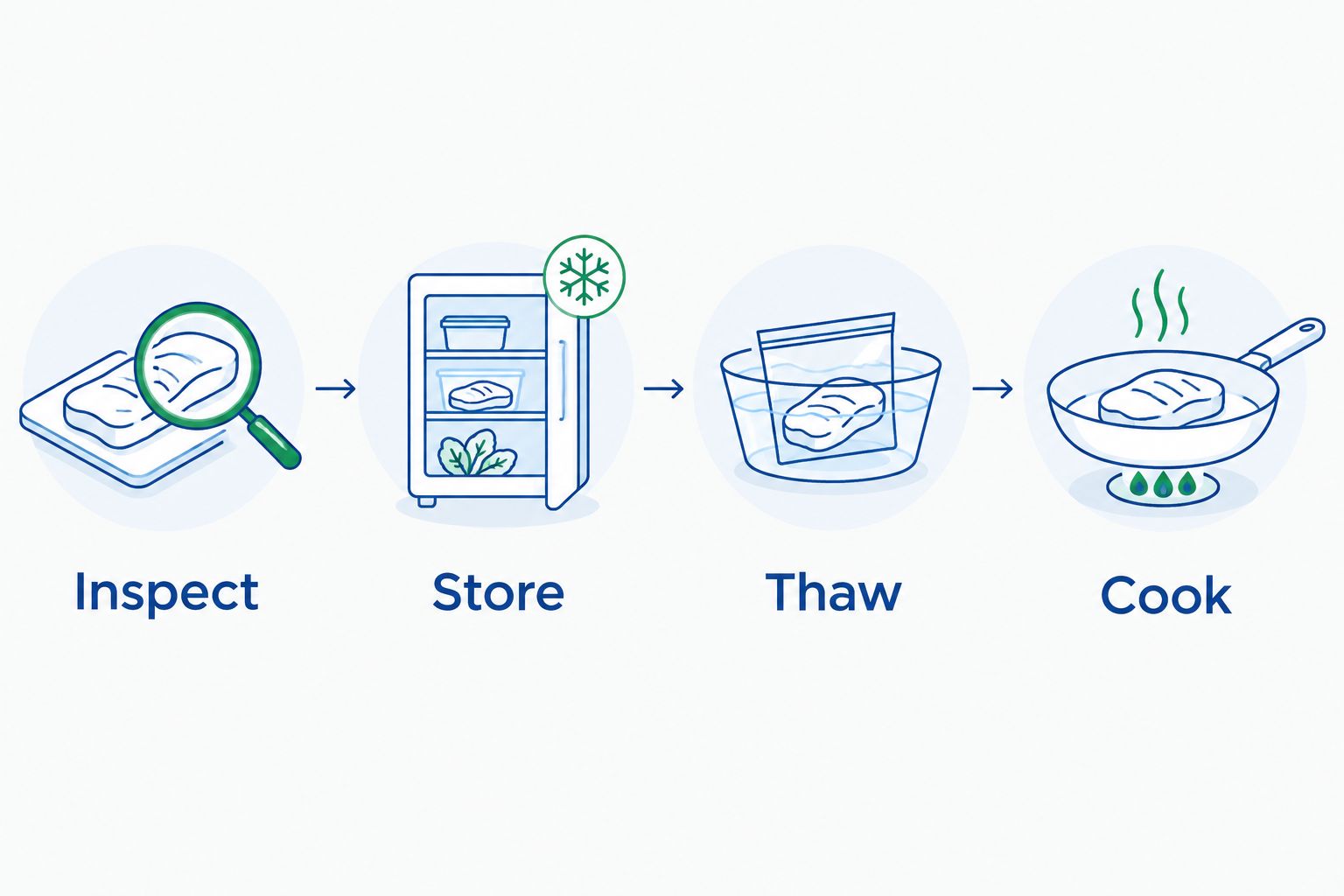
Coordinate the meat and shrimp
- Thaw under refrigeration. Keep meat and seafood in separate, contained packages. Follow package directions, including any requirement to remove seafood from reduced-oxygen packaging before thawing.
- Prepare the sides first. Finish the salad, set the table, and organize the vegetables before either protein reaches the pan. Keep raw seafood away from these ready-to-eat ingredients.
- Dry and season the ingredients separately. Pat thawed raw shrimp dry for pan cooking. Use separate plates and utensils so raw meat juices cannot reach cooked seafood.
- Cook the beef for the chosen recipe. For intact beef steaks, USDA guidance specifies 145°F followed by at least a 3-minute rest. Ground meat follows different temperature guidance; do not apply the steak rule to every meat product.
- Cook the raw shrimp near serving time. FDA guidance uses 145°F for most seafood and describes cooked shrimp flesh as pearly and opaque. Check the thickest part with a suitable thermometer rather than relying on a fixed skillet time.
- Slice and serve. Cut the beef across the grain and plate beside the shrimp. Use clean serving utensils and add the finishing sauce after the proteins are ready.
Expected result: the beef has completed its required rest, the shrimp are cooked through, and neither protein waits through unfinished side dishes.
Do not force both proteins into one pan. Separate cooking gives you control over doneness and keeps a delicate seafood ingredient from waiting for a thicker piece of meat.
Second workflow: a chilled seafood starter
For a 2026 dinner-party menu, serve cooked shrimp as a chilled starter and prepare the beef afterward. Cooked 16-20 White Shrimp P&D T-On is best for this variation because the product title explicitly identifies it as cooked.
- Thaw according to package directions under refrigeration.
- Keep the shrimp cold while preparing the serving plate and accompaniments.
- Serve the starter, then begin the meat course with clean equipment.
The advantage is less last-minute coordination. The limitation is that cooked shrimp should not be treated as raw shrimp and given the full skillet-cooking sequence above.
Frozen Lobster Cooked Claw & Knuckle Meat offers another variation. Follow its handling directions and use a recipe written for cooked lobster; repeated cooking can toughen the meat.
Troubleshooting
- The package is larger than your meal plan. Recheck EACH versus CASE before ordering. After delivery, portion only when the product's format and handling directions permit; do not pry pieces from a solid frozen block with a knife.
- The shrimp release liquid and steam. Thaw fully, drain, pat dry, and cook in uncrowded batches. Do not raise the heat while leaving the same crowded, wet pan unchanged.
- The beef seems chewy despite reaching temperature. Check the direction of the muscle fibers and slice across them. Also confirm that the chosen recipe suits the cut rather than treating chuck flap as an interchangeable tender steak.
- The seafood is ready before the meat. Prepare sides earlier and separate the cooking stages. For the next dinner, finish the beef's cooking before starting the raw shrimp.
- You cannot verify the delivered food's temperature. Do not use smell or taste as a substitute. Follow USDA mail-order food guidance and contact the seller about a questionable delivery.
Customize your workflow
Save a reusable 2026 menu note with your guest count, portion targets, confirmed package units, and cooking order. After dinner, adjust your own portions based on what your household actually ate—not a generic serving claim.
Onatru's ingredient range lets you change the seafood component while retaining the same planning method. Keep the receiving, storage, and separation steps; rewrite the cooking stage whenever you switch between raw shrimp, cooked shrimp, and cooked lobster.
For the practical next step, use the guide to portioning a large shrimp order for your freezer. A repeatable portioning plan makes the surplus part of another dinner instead of an unidentified package.
FAQ
What's the easiest way to build a surf and turf meat and shrimp order?
Choose the menu and portions before selecting packages. Pair a meat suited to your recipe with clearly labelled shrimp, then confirm purchase units and storage requirements.
Does this guide describe a preset Onatru surf and turf box?
No. This guide explains how to assemble a dinner from individually selected meat and seafood ingredients; it does not identify a named preset bundle.
Should I choose raw or cooked shrimp for steak and shrimp?
Choose raw shrimp when you want to cook the seafood for a hot main course. Choose cooked shrimp for a chilled starter or a recipe specifically written for cooked shrimp.
How much meat and shrimp should I plan for four adults?
One adjustable planning example is 24 ounces of boneless raw beef and 12 ounces of raw peeled shrimp for four adults. That assumes 6 ounces of beef and 3 ounces of shrimp each, not a universal serving requirement.
Can I cook the beef and shrimp in the same pan?
Separate cooking is easier to control because beef and shrimp reach doneness differently. Keep raw-food utensils separate from cooked-food utensils and verify each protein's doneness independently.
What temperature should a refrigerated seafood delivery arrive at?
USDA mail-order food guidance specifies refrigerator-cold food at 40°F or below, or food that remains frozen or partially frozen with ice crystals. Do not eat perishable food that arrives above 40°F; contact the seller.
Can I replace the shrimp with cooked lobster meat?
Yes, but use handling and preparation instructions written for cooked lobster. Frozen Lobster Cooked Claw & Knuckle Meat is identified as steam-cooked and stored frozen, so it should not follow a raw-shrimp cooking sequence.
One last thing
The most useful part of your surf and turf box is the note you put beside it. Write the dinner portions, the remaining quantity, and the next planned meal before storing anything. That small decision turns a large ingredient order into an organized home-kitchen routine.


