

Instead of shopping for seafood before every dinner, stock your freezer with shrimp and lobster in labeled, meal-size packs, then replace what you actually cook. This guide turns buying, receiving, portioning, and thawing into a repeatable home-kitchen routine for 2026—not a reason to fill every shelf at once.
- To stock freezer with shrimp and lobster, choose meal-size portions, verify freezer temperature, and rotate older packs first.
- Onatru suits home cooks ordering restaurant-quality seafood nationwide; match each product’s pack size to your freezer space.
- Keep frozen seafood at 0°F or below; thaw refrigerated portions at 40°F or below.
- Choose raw shrimp for cooking, cooked lobster meat for simpler preparation, and lobster tails for plated dinners.
Why this matters
A useful seafood freezer holds dinners you know how to make, not packages you keep postponing. A large order becomes inconvenient when you must thaw the whole block to get one meal.
Onatru sells restaurant-quality ingredients and ships nationwide to home cooks. That makes ordering seafood for several meals an option, but the product’s preparation state and ordering unit still need to fit your kitchen.
For your 2026 freezer plan, separate two decisions: what you enjoy eating and what you can conveniently store. Peeled shrimp reduces preparation work; shell-on shrimp leaves you with peeling; lobster tails require shell handling; cooked lobster meat removes the initial cooking step. None replaces proper temperature control.
Before you start
- Check storage and equipment. You need freezer space, a freezer thermometer, freezer-safe packaging, a marker, a kitchen scale, and a tray for refrigerator thawing. USDA and FDA home-storage guidance calls for a freezer at 0°F or below and a refrigerator at 40°F or below.
- Check the order before paying. Read the product title, raw or cooked status, frozen or refrigerated instructions, ordering unit, and delivery information. Confirm whether you are selecting an individual package or a case, and arrange to receive and unpack the delivery promptly.
- Watch for the block-freezing gotcha. Individually frozen pieces and a solid frozen block behave differently. Do not assume you can divide a sealed block while frozen; check the format before ordering, and never use a knife to pry apart hard-frozen seafood.
Your freezer menu and order plan
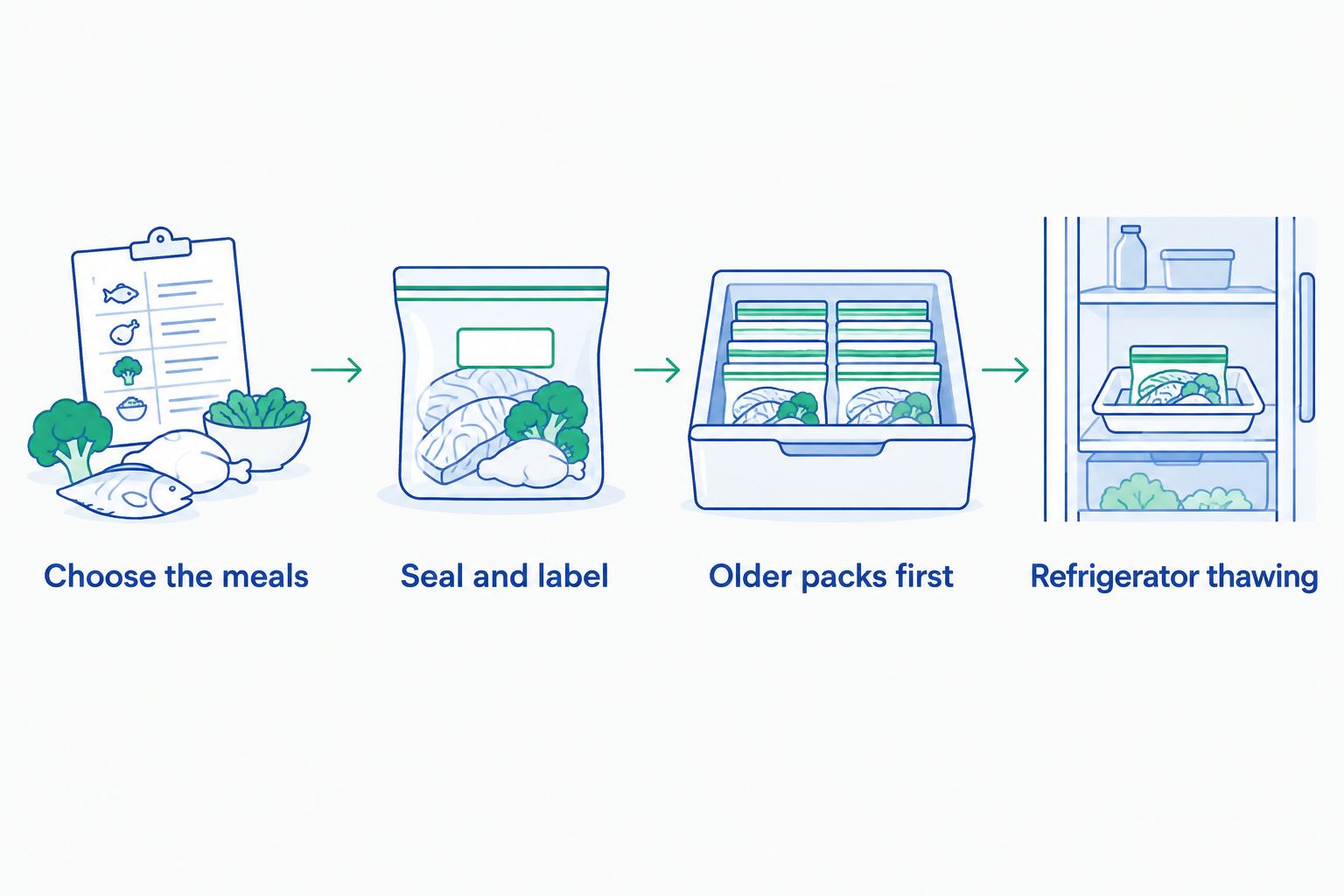
- Choose the meals first. Write down dishes you already cook: shrimp tacos, shrimp pasta, lobster rolls, or a lobster-tail dinner. Assign seafood to each dish rather than buying several formats without a purpose.
- Choose the preparation state. Buy raw seafood for recipes that cook it. Choose explicitly cooked seafood when you want a cold preparation or a recipe that adds cooked meat near the end.
- Check the package against your meal size. Use your recipe’s seafood weight and the number of diners. Shell-on weight includes material you will not eat, so it is not interchangeable with peeled shrimp or picked lobster meat.
- Set the order limit from empty space. Leave room for the actual packages without blocking the appliance’s vents. Check the freezer manufacturer’s loading instructions before adding a large quantity of unfrozen food.
Expected result: Every package has a planned dish, a preparation method, and a place in the freezer.
Which seafood formats fit your routine?
These are preparation choices, not a ranking of seafood quality. Choose the work you want to do at dinner time.
| Format | Best for | Practical advantage | Trade-off |
|---|---|---|---|
| Raw peeled and deveined shrimp | Tacos, pasta, and stir-fries | Less cleaning before cooking | Still needs thorough cooking; tail-on packs require tail removal for some dishes |
| Raw shell-on shrimp | Cooks who want shells for stock | Keeps shells available for a separate preparation | More handling and less edible meat per package weight |
| Frozen lobster tails | Plated lobster dinners | Separate tails simplify counting dinner portions | Shell preparation and careful cooking remain necessary |
| Frozen cooked lobster meat | Lobster rolls and finishing pasta | Removes the initial raw-seafood cooking step | Prolonged reheating can toughen the meat |
Onatru is a good fit for home cooks seeking restaurant-quality seafood delivered nationwide. The practical limitation is package fit: verify the ordering unit rather than assuming a restaurant-oriented pack matches one household meal.
For example, the listed Frozen Peeled & Deveined Shrimp Tail On 21-25 identifies the shrimp’s preparation and count category. The Frozen Lobster Tails 5-6 OZ title identifies tail size, not the total package weight. Frozen Lobster Cooked Claw & Knuckle Meat explicitly identifies cooked meat; do not transfer that assumption to another lobster product.


Your delivery check and portioning station
- Clear the route to cold storage. Prepare the freezer before opening the shipping container. Set out clean packaging and a tray so the delivery does not sit while you reorganize shelves.
- Inspect the seafood promptly. Check for damaged packaging and assess temperature, not just whether the box feels cool. FDA seafood-delivery guidance says refrigerated seafood should arrive at 40°F or below; frozen seafood should arrive frozen or partially frozen with ice crystals.
- Resolve temperature concerns before storing. Do not taste questionable seafood. If the shipment arrives warm or its handling history is uncertain, contact the seller and do not treat freezing as a way to make unsafe food safe.
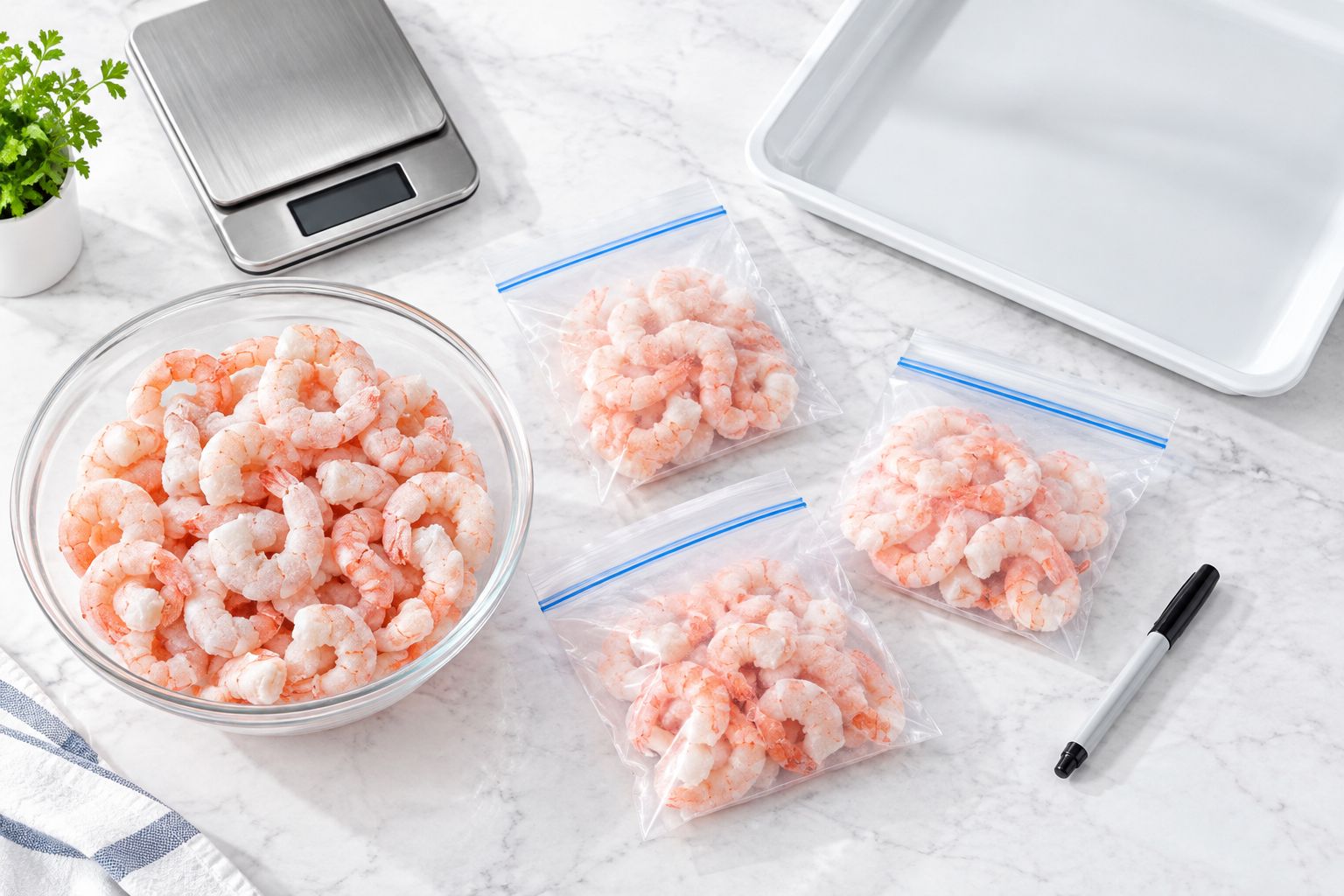
- Divide only what separates safely. Keep unopened, usable meal-size packs intact. For loose frozen pieces, transfer the amount you need into freezer-safe packaging promptly; leave solid blocks intact until you have a safe thawing plan.
- Seal and label. Remove excess air without crushing the food. On a homemade label, record Contents, Raw or cooked, Weight, Packed date, and Planned dish; preserve the original product identification and handling instructions.
Expected result: Seafood reaches cold storage promptly, with enough information to identify and use every pack.
For portioning, measure edible seafood rather than relying on a handful or an assumed shrimp count. A recipe calling for 1 lb of peeled shrimp needs 16 oz of peeled shrimp; it does not call for the same weight of shell-on seafood.
Use your own recipe to set the serving size. If a recipe uses 1 lb of peeled shrimp for four servings, divide that amount into four 4 oz raw portions—or keep it together as one family-meal pack. This is recipe arithmetic, not a universal serving recommendation.
A clear example label is: Raw peeled shrimp | 1 lb | Packed June 2026 | Taco dinner. Write the actual packing date on your own package, and never replace an existing manufacturer date with a later one.
Your storage map and thawing routine
- Create separate storage groups. Keep raw seafood securely contained and separate from cooked, ready-to-eat foods. Use bins or designated shelf areas so you can retrieve a pack without unpacking the freezer.
- Put older packs in front. Add new purchases behind existing ones. Use a paper list or a simple note with your own fields: Item, Meal packs, Packed date, and Next dish.
- Select tomorrow’s seafood today. Move the chosen pack to a tray in the refrigerator. Allow enough time for the package’s thickness; do not promise yourself a fixed thawing time for every format.
- Check reduced-oxygen packaging. Follow the package’s thawing directions. Fishery products in vacuum packaging can require removal from the package before refrigerator thawing; do not leave an unfamiliar vacuum-packed product sealed by default.
- Cook or prepare according to its state. Cook raw seafood thoroughly. FDA guidance gives 145°F as the safe internal temperature for most seafood; keep cooked seafood cold for cold dishes and follow its handling instructions.
Expected result: You can identify the next pack to use, thaw it safely, and distinguish raw ingredients from cooked ones.
For a shorter-notice dinner, follow the cold-water method in how to thaw frozen shrimp safely for dinner. Cold-water-thawed seafood needs prompt cooking; the countertop is not a thawing station.
Build your 2026 routine around choosing the next meal before you need it. You gain convenience from the planning—not from rushing frozen seafood through an unsuitable thawing method.
Replenish whenever you use a meal pack
A smaller household can use the same process without placing a large restocking order. Replace successful meals before adding unfamiliar seafood formats.
- Mark a pack as used when you move it to the refrigerator, not after dinner. Your freezer list then reflects what remains frozen.
- Note whether the quantity suited the recipe. Change the next portion if you repeatedly have too much or too little.
- Review remaining packs before ordering again. Combine the inventory check with your usual meal planning, rather than assuming a standing schedule fits your consumption.
- Reorder the format you enjoyed and have room to store. Add another format only when you have a dish planned for it.
Expected result: Your 2026 seafood list follows actual dinners instead of growing into an accumulation of forgotten packages. This is a manual household routine, not a claim about an automatic ordering feature.
Troubleshooting your seafood freezer
The shrimp is frozen into one block
Do not chip at it with a knife. Thaw in the refrigerator according to package directions, then portion safely; USDA guidance allows refreezing refrigerator-thawed food that has stayed safely cold, although quality can decline. Choose smaller packs or confirmed individually frozen pieces next time.
Lobster meat turns tough in the finished dish
Check whether the product was already cooked. For recipes using cooked lobster, prepare the sauce first and add the meat near the end rather than simmering it throughout; raw lobster needs its own thorough cooking step.
Packs develop dry, pale patches
Freezer burn is a quality problem caused by air exposure, not proof that food is unsafe. Improve the seal, reduce trapped air, and use older packages first; discard food when its temperature history makes safety uncertain.
The delivery is partly thawed
Use temperature and ice crystals to assess it, not the delivery date alone. USDA guidance permits refreezing food that still contains ice crystals or is at 40°F or below; if you cannot establish safe handling, do not guess.
Your list says shrimp, but you cannot find it
Replace vague entries with preparation state and pack quantity. Keep the same items together, and update the list when seafood leaves the freezer—not when you remember later.
Customize your workflow
For frequent shrimp dinners, keep your most-used preparation easy to reach. For occasional lobster meals, preserve clearly marked portions so a special dinner does not require thawing an oversized package.
Onatru’s seafood selection includes several raw, cooked, shell-on, and peeled formats, so use the product title and instructions to guide each purchase. Nationwide ordering expands your ingredient choices; checking package size and handling requirements keeps those choices manageable.
Do not interpret “all year” as a recommendation to buy a year’s supply. Keep the routine running throughout 2026, and replenish as you cook. Follow product-specific storage instructions and USDA cold-storage guidance for quality windows rather than inventing one deadline for every seafood format.
FAQ
What’s the best way to stock a freezer with shrimp and lobster?
Stock shrimp and lobster in labeled, meal-size packs, and use older packages first. Choose the recipes before ordering, confirm the package format, and keep the freezer at 0°F or below.
Should I buy raw or cooked shrimp for freezer meals?
Choose raw shrimp for dishes that cook the shrimp and explicitly cooked shrimp for preparations designed around cooked seafood. Both need safe storage and thawing; cooked shrimp does not need another full raw-seafood cooking cycle.
Can I refreeze shrimp after thawing it?
You can refreeze shrimp thawed safely in the refrigerator, although its quality can decline. Shrimp thawed by cold water or microwave should be cooked before refreezing, according to USDA guidance.
Should I freeze lobster tails or cooked lobster meat?
Choose lobster tails for plated dinners and explicitly cooked lobster meat for recipes such as lobster rolls. Tails require shell handling and cooking; cooked meat simplifies preparation but can toughen with prolonged reheating.
How do I know whether a seafood delivery is cold enough?
Refrigerated seafood should arrive at 40°F or below, and frozen seafood should arrive frozen or partially frozen with ice crystals, according to FDA guidance. Check promptly and contact the seller about questionable temperatures rather than tasting the seafood.
Can I thaw frozen seafood on the kitchen counter?
Do not thaw seafood on the kitchen counter. Use refrigerator thawing or an appropriate cold-water method, follow package directions, and cook cold-water-thawed seafood promptly.
Does stocking seafood all year mean buying everything at once?
No—stocking seafood all year means maintaining a useful supply and replacing what you cook. Order quantities that fit your freezer and your meal plans rather than treating a large purchase as the goal.
One last thing
Write a dish on the label, not just an ingredient. A pack marked shrimp still leaves you with a decision; a pack marked shrimp tacos gives you a place to start.
Keep that promise simple. The best-stocked freezer is the one that helps you cook dinner with confidence.


