

Frozen lobster keeps its best quality for 2–4 months in the freezer, according to FoodSafety.gov’s cold food storage chart for fresh lobster. That is a quality guideline, not a safety expiration: lobster handled safely before freezing and kept continuously at 0°F or below remains safe indefinitely. For your 2026 freezer plan, follow the package’s storage instructions and remember that freezing does not make previously mishandled seafood safe.
- How long does frozen lobster last in the freezer? FoodSafety.gov lists 2–4 months for best quality for fresh lobster.
- USDA distinguishes safety from quality: food kept continuously frozen at 0°F remains safe indefinitely.
- Onatru seafood buyers should check package instructions, label freezer portions, and plan meals before quality declines.
- Thaw lobster in the refrigerator, not on the counter; follow special instructions for vacuum-packed seafood.
Why this matters
A freezer date tells you about quality; temperature history tells you about safety. Lobster that stays properly frozen can lose its appealing texture without becoming unsafe solely because another month has passed. Conversely, a recently purchased package is not safe if it has been mishandled.
Onatru is suited to home cooks ordering restaurant-quality seafood for nationwide delivery. The practical trade-off is planning storage and thawing before dinner, rather than treating a delivered ingredient as ready to cook straight from the box.
How long does frozen lobster last in the freezer?
Use 2–4 months as the general best-quality freezer window for fresh lobster, with continuous storage at 0°F or below. FoodSafety.gov’s Cold Food Storage Chart supplies that lobster-specific window; USDA’s Freezing and Food Safety guidance explains why continuous freezing separates safety from eating quality.
These sources answer different questions. The chart helps you decide when to serve lobster at its best, while the USDA guidance explains why passing a freezer-quality window does not automatically mean food must be discarded.
| Storage situation | What the guidance means | Your next move |
|---|---|---|
| Fresh lobster frozen at home | FoodSafety.gov lists 2–4 months for best quality | Date the package and schedule a meal within that window |
| Commercially frozen lobster | Product-specific processing and packaging require attention to the label | Follow the manufacturer’s storage and handling instructions |
| Lobster continuously frozen beyond the quality window | Time alone does not make continuously frozen food unsafe | Review packaging, temperature history, and expected texture |
| Lobster that thawed or warmed during storage | The original freezer date cannot establish safety | Assess its temperature history before cooking or refreezing |
For a 2026 kitchen reference, keep this distinction beside your freezer inventory: best quality is not the same as safe indefinitely. Indefinite frozen safety assumes the food was safe when frozen and stayed continuously frozen; it is not permission to ignore a damaged package or an unknown thawing event.
Home-frozen lobster: 2–4 months for best quality
Home freezing works best when you start with properly handled lobster and protect it from air. Do not use the freezer to postpone a decision about seafood that already shows spoilage or has spent too long unrefrigerated.
The advantage is flexibility: you can reserve portions for a later dinner. The limitation is that household wrapping and repeated handling expose the lobster to drying and physical damage, so careful packaging matters.
If you freeze several portions, label each with the contents and freezing date. Include whether the lobster is raw or cooked; that detail becomes surprisingly easy to forget once everything is wrapped.
Commercially frozen lobster: follow the package instructions
Commercially frozen lobster comes with handling details that a general freezer chart cannot replace. Read the label for storage instructions, thawing directions, and whether the contents are raw or fully cooked.
An intact original package saves unnecessary handling. Its limitation is that opening it changes the storage situation: once you remove part of the contents, the remaining lobster needs effective protection from air and moisture loss.
For an Onatru lobster order, check the actual package rather than assuming every cut has the same preparation instructions. A tail, a whole lobster, and picked meat are different kitchen tasks, even when all are destined for the same freezer.
Why frozen lobster’s quality varies
The calendar is only part of the picture. These factors explain why two packages frozen on the same day do not necessarily cook or taste alike:
- Starting condition: Freezing preserves food; it does not reverse spoilage or repair poor handling before freezing.
- Air exposure: Loose wrapping and damaged seals allow moisture loss, which contributes to freezer burn.
- Temperature consistency: Partial thawing and refreezing affect texture and require a separate safety assessment.
- Package condition: Punctures, open seams, and crushed wrapping leave the lobster less protected during storage.
- Product instructions: Raw lobster, cooked lobster, and prepared lobster dishes need handling appropriate to their actual form.
For your 2026 meal planning, prioritize packages with opened outer wrapping or weaker protection, provided the lobster has remained safely frozen. Keep securely sealed portions for later meals rather than repeatedly opening every package to inspect it.
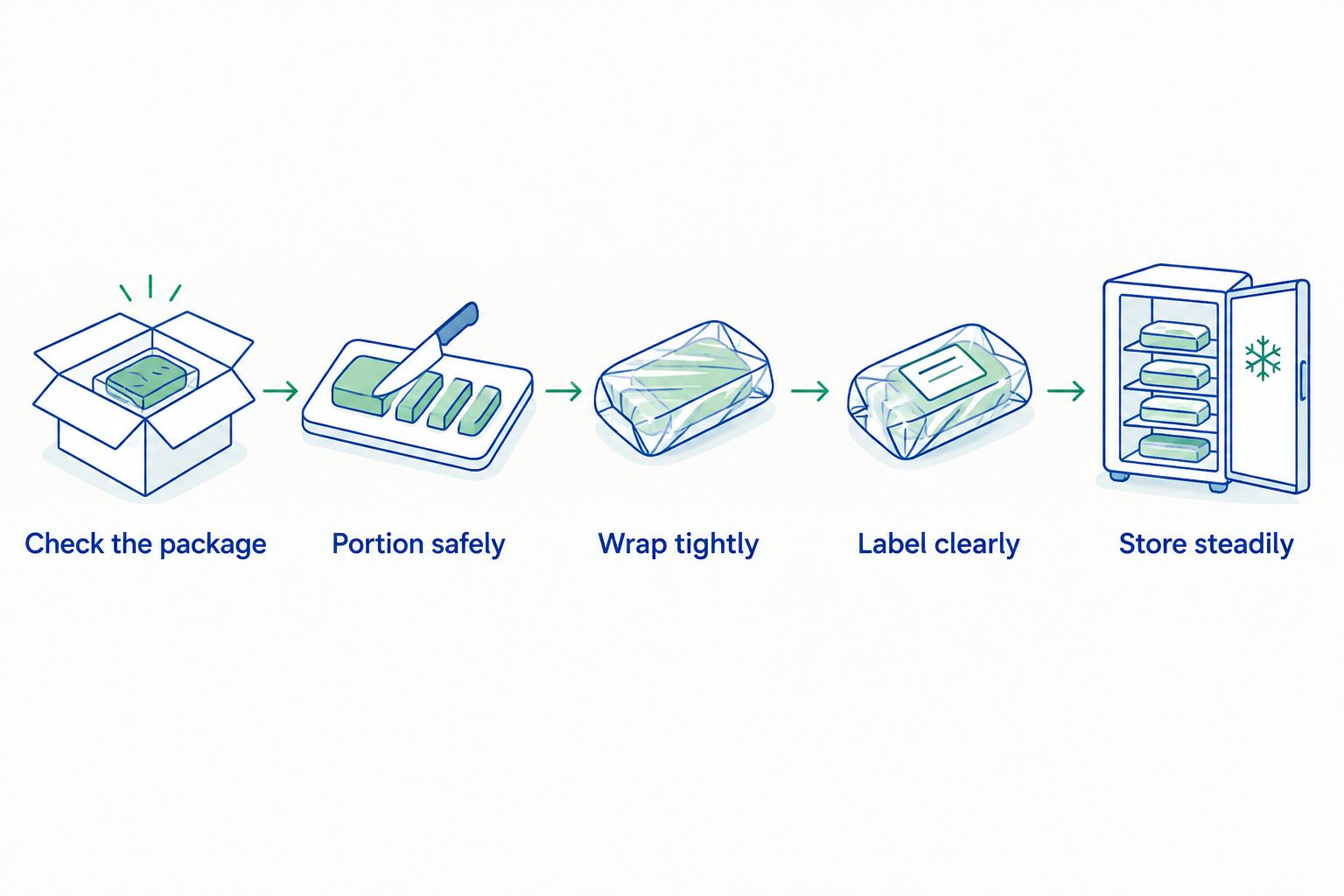
How should you package lobster for the freezer?
Protect the lobster from air, preserve its instructions, and make each portion easy to identify. There is no benefit to repeatedly unwrapping a sound commercial package just to replace it with household wrapping.
- Check the package. Read the storage and thawing directions before putting the lobster away. Confirm whether it is raw or cooked.
- Portion safely. If the product separates while frozen, set aside only what you need. Do not leave it on the counter to soften for portioning.
- Wrap tightly. Use freezer-suitable packaging and remove excess air without crushing the contents. Protect wrapping from sharp shell edges.
- Label clearly. Record the contents, freezing date, and any handling instructions that would otherwise be lost with the outer carton.
- Store steadily. Keep lobster in a stable part of the freezer, with older portions positioned where you will see them first.
A simple sequence is easier to repeat than an elaborate storage system. The goal is to avoid finding an unmarked package months later and having to guess what is inside.
What should you check when frozen lobster arrives?
Inspect the seafood promptly rather than leaving the delivery unopened while you finish other errands. FDA seafood guidance advises checking that frozen seafood is hard and that packaging is intact; signs of thawing or refreezing deserve attention.
A shipping carton that feels cool does not establish the temperature of the food inside. If lobster arrives thawed, evaluate the food’s actual temperature and handling history rather than assuming the original frozen-storage timeline still answers the safety question.
Photograph damaged packaging and retain the label if you need to ask the seller about the shipment. Our guide to inspecting and storing a delivered lobster order covers the arrival check in more detail.
How do you thaw frozen lobster safely?
Refrigerator thawing is the straightforward choice for home cooks. Keep the refrigerator at 40°F or below, place the lobster in a leakproof container or on a rimmed tray, and keep raw seafood separate from ready-to-eat foods.
Read the package before beginning. Vacuum-packed seafood can carry instructions to remove it from reduced-oxygen packaging before thawing; follow those instructions rather than leaving the sealed pouch in the refrigerator by habit.
For cold-water thawing, use appropriate leakproof packaging, keep the seafood in cold water, and change the water every 30 minutes, following USDA thawing guidance. Cook immediately after this method, and do not use warm water to speed things along.
Thawing time depends on the package and the size of the lobster. Plan ahead instead of relying on one universal overnight promise, especially for a solid block of meat or a larger package.
Can you refreeze lobster after thawing it?
0°F is the freezer-storage target, but safe refreezing depends on how the lobster thawed. USDA guidance permits refreezing food thawed in the refrigerator, although moisture loss can reduce quality.
Food thawed using cold water or a microwave should be cooked before refreezing. Refreezing does not erase unsafe time at warmer temperatures, and it does not restart the lobster’s quality history as though it were newly purchased.
For your 2026 freezer routine, record a thaw-and-refreeze event on the package. That small note helps you choose the portion to use next without relying on memory.
Does freezer burn mean lobster is unsafe?
2–4 months is a quality guideline, and freezer burn is also primarily a quality problem. USDA explains that freezer burn results from air reaching the food’s surface; it does not itself make food unsafe.
Dry, pale, or leathery areas can produce a disappointing meal even when the food has remained safely frozen. Better wrapping helps prevent further drying, but it cannot restore moisture already lost.
Do not confuse freezer burn with evidence of spoilage after thawing. Sour, rancid, or ammonia-like odors are reasons not to eat seafood, and a normal appearance or smell cannot prove that mishandled food is safe.
What happens if your freezer loses power?
0°F remains the storage goal; after an outage, check the food rather than guessing from the clock alone. USDA guidance allows refreezing food that still contains ice crystals or is at 40°F or below, although quality can decline.
Keep the freezer closed while you assess the situation. A freezer thermometer helps establish conditions, but a reading taken after power returns does not reconstruct every earlier temperature.
Perishable seafood held above 40°F for more than 2 hours should be discarded under federal food-safety guidance. If you cannot establish safe handling, do not taste the lobster to decide whether to keep it.
FAQ
Is frozen lobster still good after six months?
Six months is beyond FoodSafety.gov’s 2–4-month best-quality window for fresh lobster, but it is not automatically unsafe. Lobster handled safely before freezing and kept continuously at 0°F or below remains safe indefinitely; texture and flavor can decline.
Can I eat lobster that has been frozen for a year?
A year in the freezer does not by itself make continuously frozen lobster unsafe. Confirm that it was safe before freezing and stayed at 0°F or below, and expect quality to be less predictable than within the recommended window.
What temperature should I keep frozen lobster at?
Keep frozen lobster at 0°F or below. Use a freezer thermometer and follow any additional storage instructions on the product label.
Does vacuum sealing make frozen lobster last forever?
Vacuum sealing does not prevent all quality loss or make unsafe lobster safe. It limits air exposure, but you still need continuous freezing and must follow the package’s thawing instructions.
Can I thaw lobster on the kitchen counter?
Do not thaw lobster on the kitchen counter. Use refrigerator thawing or an appropriate cold-water method, following the product’s packaging instructions.
How can I tell whether thawed lobster has spoiled?
Discard thawed lobster with sour, rancid, or ammonia-like odors. Smell and appearance cannot establish safety, so also consider temperature history and handling.
Should I buy more lobster just because I have freezer space?
Buy an amount you can protect, identify, and schedule into meals. For Onatru seafood orders, check the package quantity and storage directions before deciding how much fits your home routine.
One last thing
Put the cooking plan on the freezer label, not just the date. A note such as lobster rolls, pasta, or surf and turf turns an anonymous frozen package into a dinner you will remember to make.
Make that your 2026 habit: inspect it, protect it, and give it a place on the menu. You do not need a complicated system to bring a little wow to the table—just lobster that has been handled safely and used while its quality still suits the meal.


